Showing posts with label michael t. young. Show all posts

Tuesday, March 13, 2018

From Manuscript to Book: Editing and Revising


All manuscripts accepted for publication by Terrapin Books are carefully edited. Several months before I plan to publish the book, I send instructions to the poet on how to prepare the manuscript for editing. I then go through the manuscript and mark it up with red comments. I send it back to the poet who then makes the fixes and returns the manuscript to me.

Typically, we go back and forth a few times, negotiating, discussing, agreeing, disagreeing, and eventually arriving at the final version of the manuscript. (Well, not quite final as there are invariably some additional errors that reveal themselves once the book is formatted and returned to the poet for proofreading.)

Following is a Q&A I conducted with Michael T. Young about the editing and revising process we engaged in with his forthcoming book, The Infinite Doctrine of Water. It should give you a good behind-the-scenes peek at what goes into book production at Terrapin Books.


Diane:  I recall that when I accepted your manuscript I right away suggested a structural change, that is, I suggested that your three sections become five. Do you recall why I made that suggestion? How did you implement it and to what effect? How difficult was it to make that change?

Michael:  Yes, I recall you felt the poems were dense and thought-provoking and, consequently, that some extra space could help them. This change made sense to me since I intend my poems to be thought-provoking. Grouping them into shorter sections would provide greater thematic focus and, at the same time, more intervals in which the reader could digest all they elicit.

I tackled the restructuring by rereading the whole collection and looking for additional thematic arcs within each section. Given that the original first two sections were rather long and the final section rather short, I focused on those first two sections. It was somewhat easy to break these into four sections with coherent thematic arcs. The first section was the easiest, requiring no shuffling of the poems. The other three new sections required a little tinkering with the order of poems both within and across sections to give them coherence. This was also influenced by the need to reorder poems from the final section which had an abundance of poems with water imagery. Moving those poems across the other three prior sections helped create connections across sections and filled in gaps within sections that were wanting. The process was somewhat slow since every reshuffling required I reread entire sections and try to hear both the individual pieces and how the whole related.


Diane:  Early on I was also concerned about your overuse of light images and the repetition of the word light. Were you aware of the excess when you assembled the collection? How did you go about fixing this? How did those edits change the manuscript?

Michael:  I’ve always had a penchant for light and related images. Even my previous two collections have an abundance of such images. When one is publishing individual poems in journals this is, of course, not an issue. It’s only an issue when assembling a collection.

I employed a number of approaches to handle the abundance of light references and light images in The Infinite Doctrine of Water. In some instances, I moved a poem to a different location to soften its resonance with other poems that had similar imagery. In some instances, I changed a word or simply deleted it. In still other instances I changed the word light or an image of light to darkness or some related image that was opposite. These changes resulted in a more dynamic relationship among all the poems in the book, even those that use light images. As Donald Justice wrote, “To shine is to be surrounded by the dark.”


Diane:  Point of view was another issue. I noticed an excessive reliance on first person I. Tell us how you addressed this point of view issue. How did the changes you made affect the collection?

Michael:  This abundance wasn’t as difficult to correct as the use of light. A few of the poems were in first person in only a minor way. That is, a few of them had a first person pronoun in only one sentence but the rest of the poem made no direct reference to the speaker. Removing the single first person pronoun from these poems was rather easy. This, combined with reshuffling some of the other second and third person poems from the final section throughout the rest of the collection, provided for a balance the collection didn’t have in its original form. I was very grateful to rework this aspect of the book through the editing process.


Diane:  I also made editorial suggestions for a number of individual poems. What kinds of changes did I suggest? Were you always agreeable? Give us a few examples of poems that were revised during this process of preparing your manuscript for book form.

Michael:  Suggested changes ranged from comma insertions and stanza breaks to changes of diction and a few line deletions. I wasn’t always amenable to changes. For instance, with the poem “Sage.” This poem contained the word light and you suggested it be removed and another word used. But I felt any alternatives I came up with didn’t say exactly what needed to be said or failed rhythmically to keep with the tone of the poem. It was one of the few that I didn’t change.

But there were a number of good changes made. For instance, in “Close Reading,” we changed the word skirred to skirted. Although skirred was the more precise word, it is unfamiliar and likely to have been read as a typo by readers. This was something you pointed out and I thought it was a reasonable assumption. So the change seemed a good one.

A few concluding lines were removed altogether, as in the poems “Setting Fires” and “Paperclip.” Both these poems were afflicted by my old habit of providing the reader with a kind of summation which dampened what was otherwise a strong poem. Removing such summations allowed the poems to resolve in a strong image.


Diane:  Your original title was Turpentine. I recall saying that while I very much liked the poem from which that title was taken, I didn’t think it fit or did enough work for the collection. I suggested several other possibilities. What made you choose The Infinite Doctrine of Water?

Michael:  The Infinite Doctrine of Water was another title I had been considering. In fact, when I prepare manuscripts for submission, I often prepare both a full-length collection and a chapbook to send to publishers. In preparing the chapbook which corresponded to this full-length collection, I was using the title The Infinite Doctrine of Water for that chapbook.

Like light, water also is a very important image to me and moves throughout all my poetry. So the change was really an easy one. In fact, as soon as we changed it and were, at the same time, in the midst of revising and reordering, it became immediately obvious that “The Voice of Water” was the ideal final poem for the collection, when originally it was earlier in the final section. Additionally, would it be too much to say that as soon as we changed the title, ideas for the book cover flooded my mind? For all these reasons, the title change seemed immediately right.


Michael T. Young is the author of two previous poetry collections, The Beautiful Moment of Being Lost (Poets Wear Prada, 2014) and Transcriptions of Daylight (Rattapallax Press, 2000). He is also the author of the chapbooks, Living in the Counterpoint (Finishing Line Press, 2013), winner of the Jean Pedrick Chapbook Award, and Because the Wind Has Questions (Somers Rocks Press, 1997). His work has been published in such journals as Cimarron Review, The Cortland Review, Little Patuxent Review, Potomac Review, and Valparaiso Poetry Review. He is a past recipient of a poetry fellowship from the New Jersey State Council on the Arts and has been featured on Verse Daily.


Michael’s book, The Infinite Doctrine of Water, will be released on April 1. It is now available for
Pre-orders.

Thursday, April 30, 2015

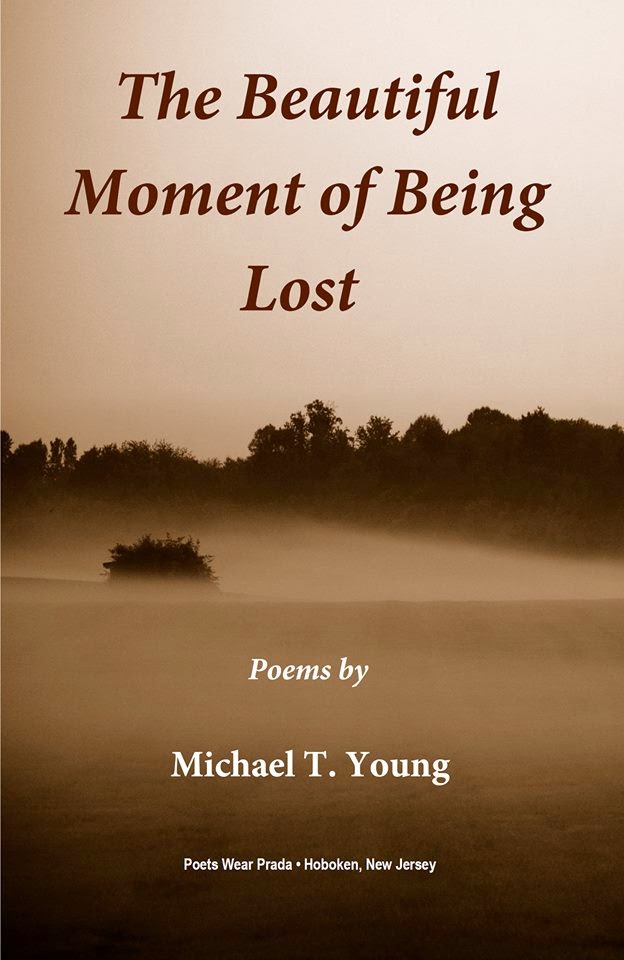
Featured Book: The Beautiful Moment of Being Lost, by Michael T. Young


The Beautiful Moment of Being Lost. Michael T. Young. Poets Wear Prada, 2014.

http://www.amazon.com/Beautiful-Moment-Being-Lost/dp/0615971105/ref=sr_1_1?s=books&ie=UTF8&qid=1427479105&sr=1-1&keywords=the+beautiful+moment+of+being+lost
Click Cover for Amazon
Michael T. Young has published four collections of poetry, most recently, The Beautiful Moment of Being Lost. He’s the recipient of a poetry fellowship from the New Jersey State Council on the Arts and the 2014 Jean Pedrick Chapbook Award for his collection, Living in the Counterpoint. He’s also received the Chaffin Poetry Award. His work has appeared in numerous journals including Fogged Clarity, The Louisville Review, The Potomac Review, and Rattle. He lives with his wife, children and cats in Jersey City, New Jersey.

Description:
. . . explores the difficulties and necessities of violating expectation, both one’s own and those of others. Through this necessary risk meaning and growth are found. Throughout the exploration, questions of memory and history, loss and identity are probed.

Blurb:
In The Beautiful Moment of Being Lost, poet Michael T. Young writes with a “dangerous brilliance.” Keening through histories, personal and collective, Young guides the reader to unimagined destinations. Rather than feeling lost, however, the reader arrives at termini of discovery, finding them to be inevitable, necessary, earned. Young enacts these journeys through cognitive leaps that defy reason and syntax, performed by his prodigious wizardry. And as the unknown becomes known, what is lost is regained, for these poems are redemptive. Each one is bathed in a luminosity of phrasing Wallace Stevens would have envied. Young writes, “[H]ear the voice in light / whose only utterance is melting snow.” Unlike snow, these poems will not disappear as long as important poetry continues to matter.  (Dean Kostos)


The Beautiful Moment of Being Lost

The secrets of a place are in its small streets,
its narrow passages, the alley in Venice
with cobblestones worn down and wet
by the humidity and dank progression of centuries,
the way we turned the same corner as others
in different years had turned into that dead-end
with its dark alcove, back doors and a wall
gaping with a niche containing a statue
of the Madonna and child, or in Florence
along a street where we pressed
into the painted brick to let a bus go by
while you pulled my backpack out of the way;
gnarled streets in Amsterdam, lower
Manhattan, passages like crooked fingers
pointing the way back to childhood,
when I liked to hide in closets, crouch
in a hamper full of clothing or make a tent
out of a bed sheet. Or the passes
and cul-de-sacs stumbled on in a beautiful
moment of being lost, the way we come
into life, without intention, snug in the primal dark.


More Poems:

The Adirondack Review

Rattle
with audio


Click Here to Purchase


Wednesday, May 21, 2014

West Caldwell Poetry Festival: A Photo Tour


The West Caldwell Poetry Festival was held on Sunday, May 18. This was the 11th year I've run this event, but this year I made significant changes to the format. It seemed like time for a change. In the past the focus was on literary journals and the event was called Poetry Festival: A Celebration of Literary Journals. Each of 12 journal editors invited two representative poets to read, so we had a total of 24 poets reading.

This year I changed the focus from journals to poets with new books. I invited six such poets. I invited journals but only eight this time as I knew I would need table space for the four book publishers I also invited. Then I structured the day into four time slots: two for readings, one for a publishers' panel, and one for a creative process panel with the six poets. I built in twenty minutes between each time slot so that visitors would have time to purchase books and journals.

The day was absolutely exhilarating. I could not have been happier with the entire event. We had a much better turnout than last year with a number of people coming for the first time. We sold more than twice as many books as we sold last year. And everyone seemed to have a good time. I only wish we'd had a bit more time to soak up even more poetry and poetry conversation.

To give you a sense of the day, here are some photos.

I welcome the audience

Priscilla Orr reads from Losing the Horizon

 Gary J. Whitehead reads from A Glossary of Chickens

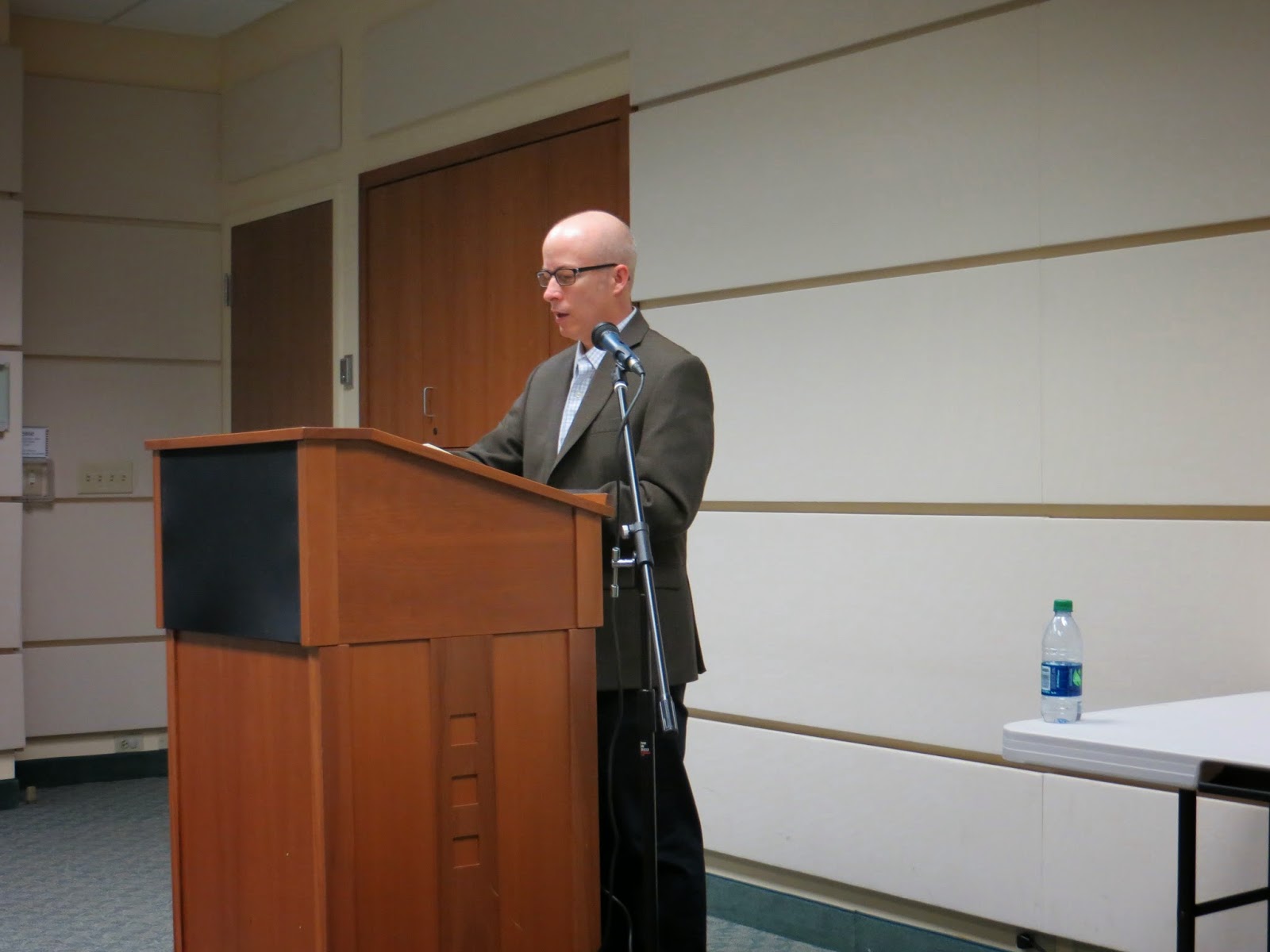
Michael T. Young reads from The Beautiful Moment of Being Lost

Publishers' Panel: Anna Evans (Barefoot Muse Press), Roxanne Hoffman (Poets Wear Prada Press),
Joan Cusack Handler (CavanKerry Press), Ellen Foos (Ragged Sky Press)

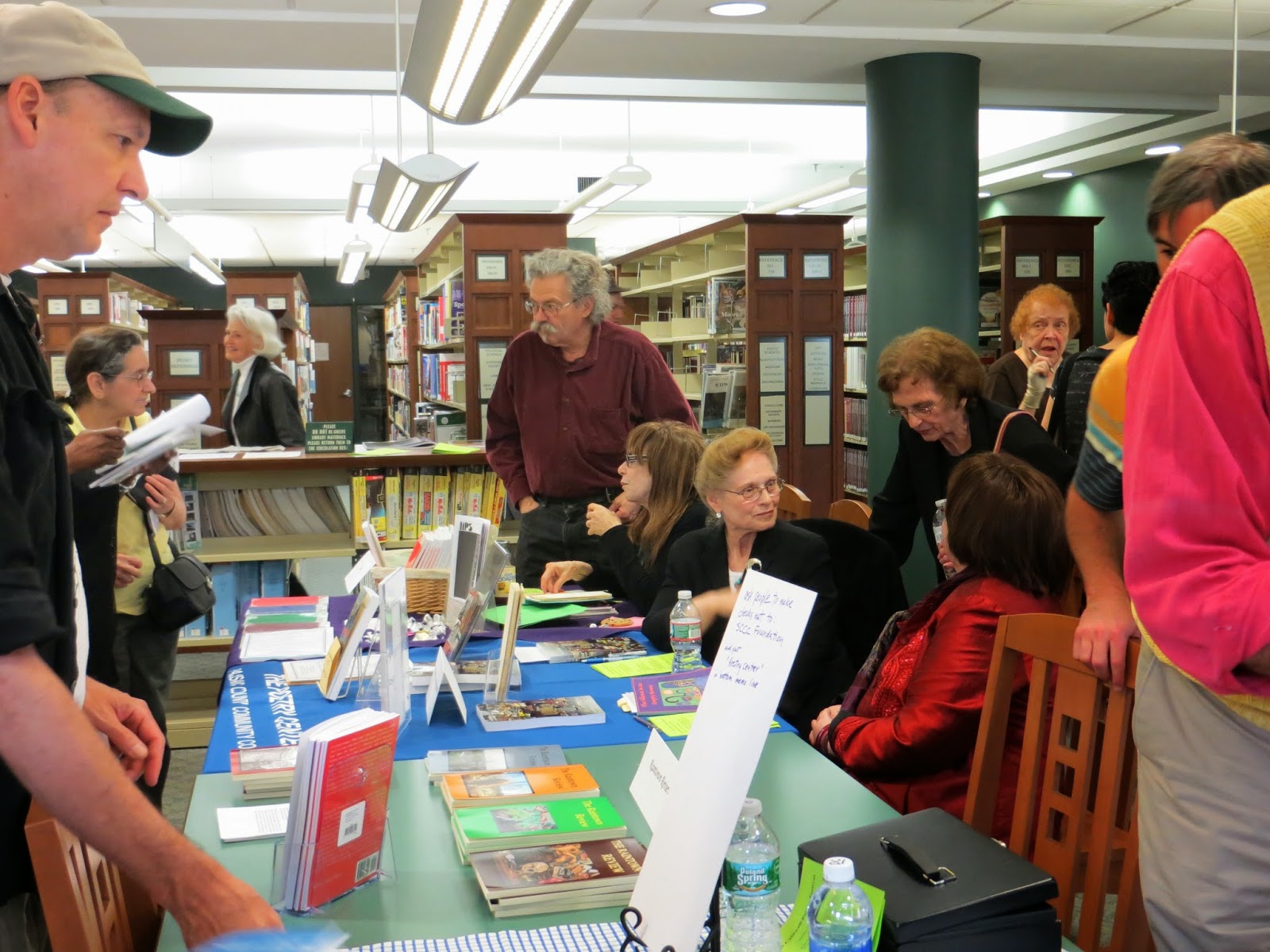
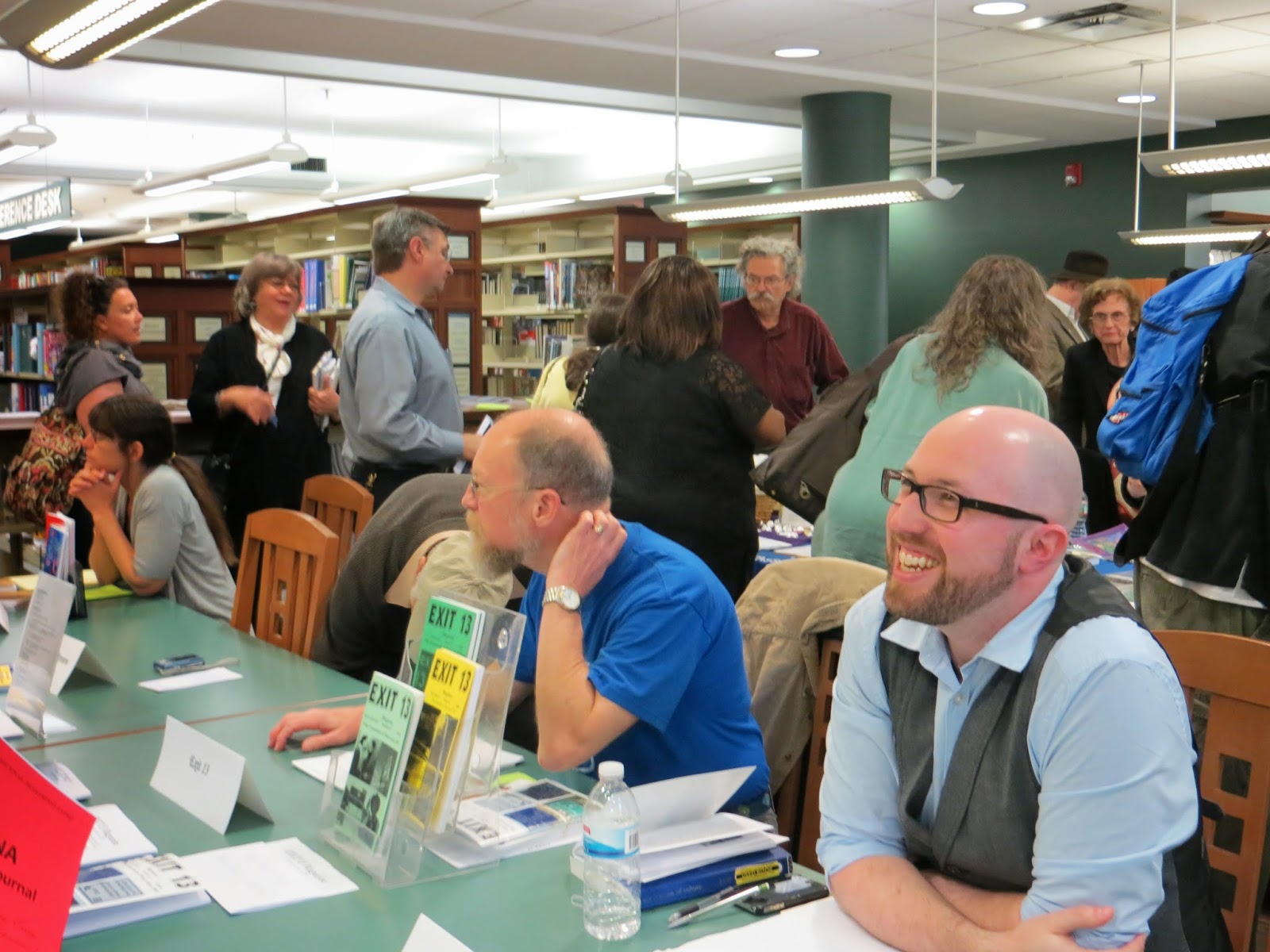
Visitors peruse the journals

Visitor poets Deb Gerrish and Chuck Tripi

Teresa Carson reads from My Crooked House

Maria Mazziotti Gillan reads from The Silence in an Empty House


Visitors browse the journals and talk with editors

Creative Process Panel with Priscilla Orr, Michael T. Young, Gary J. Whitehead, 
Teresa Carson, Maria Mazziotti Gillan, and BJ Ward

Editors Christine Waldeyer, Tom Plante, and Matt Ayres

Joan Cusack Handler and Maria Mazziotti Gillan

Poets Teresa Carson, Maria Mazziotti Gillan, and BJ Ward signing books

Michael T. Young signing his new book

Poets Maria Mazziotti Gillan and BJ Ward in conversation

BJ Ward signing his new book

Cookies for everyone!


Friday, February 21, 2014

West Caldwell Poetry Festival

For the past ten years I have run an event called "Poetry Festival: A Celebration of Literary Journals." The event takes place at my local library and has always included twelve journals and editors. Each editor has invited two poets to read for the journal, so we have had a total of 24 poets reading. After last year's festival, I seriously considered not doing it again. A number of print journals had gone out of business, so it was getting harder and harder to find journals. Also, the turnout seemed to have diminished a bit the past few years. Then one day while debating with myself whether or not I'd do it again, it occurred to me that instead of dropping it perhaps I should revise it. I began to think of ways to revitalize the festival. Before long I came up with a plan that I'm excited about.

I decided to switch the focus from journals to new poetry books. I first compiled a list of poets with new books, poets within reasonable driving distance. The list was fairly long, so I had to make choices. I hate making hard choices, but I did it. Three guy poets and three women poets. All with different presses.

I then planned the structure of the day. Two reading sessions, each with three of the poets, so each one gets to read a decent amount of time. Then I began to think of other activities with which to fill the program. I came up with a bunch of possibilities. I narrowed the list and ended up with one publishers' panel and one creative process discussion. So now I had the event divided into four segments.

I also wanted to include journals as in the past but decided to pare down to eight from twelve so that there would also be table space for the publishers.

I arranged a meeting with my librarian to present this new format and get his endorsement. He was fine with it and agreed that change is a good thing.

Next came the implementation. I issued invitations to the six poets. Within that same day I'd received an enthusiastic yes from each of them. Off to a good start! Then I invited the eight editors. Within a day or two, all eight spots were filled. Then I issued invitations to four publishers and soon had all four lined up.

The Six Featured Poets: Teresa Carson, Maria Mazziotti Gillan, Priscilla Orr, BJ Ward, Gary J. Whitehead, and Michael T. Young

The Publishers' Panel: Joan Cusack Handler with CavanKerry Press, Roxanne Hoffman with Poets Wear Prada, Anna Evans with Barefoot Muse Press, and Ellen Foos with Ragged Sky Press

The Creative Process Discussion: the six featured poets

The Journals: Adanna, Edison Literary Review, Exit 13, Journal of New Jersey Poets, Lips, Paterson Literary Review, Raintown Review, and The Stillwater Review

Books and journals will be available for sale and signing.

See the website for Schedule and details. Please mark your calendar and plan to join us!


Related Posts Plugin for WordPress, Blogger...