Showing posts with label ghost dogs. Show all posts

Thursday, April 14, 2022

Terrapin Interview Series: Dion O'Reilly Interviews Yvonne Zipter


The following is the eleventh in a series of brief interviews in which one Terrapin poet interviews another Terrapin poet, one whose book was affected by the Pandemic. The purpose of these interviews is to draw some attention to books which missed out on book launches and in-person readings. Dion O'Reilly talks with Yvonne Zipter about discovery in poetry, dealing with difficult topics, poetry and religion, and finding solace in poetry.

Dion O’Reilly:
Nature, or what we now call The Living World, is a prominent feature in your poetry. Do you consider yourself an eco-poet?

Yvonne Zipter: I’ve never actually thought about it, but I think that’s a fair label to apply to my work. If ecopoetry explores “the relationship between nature and culture, language and perception,” as Forrest Gander posits in The Ecopoetry Anthology (eds. Ann Fisher-Wirth and Laura-Gray Street), then it makes perfect sense to apply that term to my work. Kissing the Long Face of the Greyhound, for instance, is organized roughly as a dialogue between the natural world and humans, the intent being to show how they—we—are interrelated. But I tend to agree with Naturalist Weekly that “labels can be challenging for readers and writers. They have a tendency to limit our ability to see the world. One of the things I really appreciate about poetry is that any given poem may produce different meanings to different people. . . . Any poetry that gets you to think about your role or place in the natural world is beneficial and . . . the labels we give them are only helpful if they contribute to the joy of the audience.” That said, I would be honored to be thought of as an ecopoet.

Dion: Do you strive to take turns in your poems, what we call voltas or peripeteia? In other words, do you seek a deeper layer, what Robert Frost called surprise and what many poets call discovery?

Yvonne: For me, part of the joy of writing poetry is discovering what the poem is about as I’m writing it. That surprise or discovery, to my way of thinking, is an important component of a compelling poem, not only for me as the poet but for the reader as well. The delight I feel when an out-of the-ordinary perspective emerges regarding some ordinary thing—I want the reader to feel that delight as well. A poem for which the significance of the subject remains opaque to me is never successful. I end up trying to force a revelation, and the resulting poem feels empty, too glib, uninspired—boring. What I aim for in my poems is being able to take the reader along with me in the process of seeing something in a new way that might ordinarily be taken for granted. Well, that’s not quite true—I write for myself, for the joy of learning something I knew but didn’t know I knew. It’s only afterward that I think about the reader.

Dion: How do you feel poetry should deal with what some call, perhaps unfairly, darkness—topics like death, pain, "the slings and arrow?"

Yvonne: Pain, death, and adversity are common to every living being and are thus topics that should be universally relatable. As a poet, writing about these difficult topics has not only given me solace but has also been a way for me to find beauty and/or poignancy about some of life’s least pleasant moments. The hope is that such poems can allow readers to think about their difficult moments in a new way and/or help them process their own pain or grief. At the very least, poems on topics such as these let people know they are not alone in what they’ve been through.


However, much as with love poems, poems about pain and death are hard to write without falling into abstractions and clichés. I often have to let months or years pass before I can write a poem about something dire that has happened before I can focus on the kinds of details that will let me tell the reader “this was awful” without telling them that.

Dion: You have a few poems which could be interpreted as having a theme of religion versus spirituality—"Still Waters" and "Manners of the Flesh" come to mind. Is this a theme you grapple with?

Yvonne: Religion, in my poems, functions as a sort of shorthand—like myth, in a way—to convey a lot about a subject without having to elaborate in great detail because the themes, terms, et cetera are well-known. I think of myself as a spiritual person. When it comes to traditional religion, I consider myself to be an atheist, but I was raised going to church (three different denominations, actually—Lutheran, Methodist, and Unitarian) and my wife is Catholic, so despite my beliefs, I am nevertheless steeped in this culture. But because I use religious imagery so often in my poems, my wife sometimes teases me that I’m the worst atheist ever. “Manners of the Flesh” was actually written for a friend of mine who has struggled with his own relationship to religion, especially during the time his sister was dying, hence the ambivalence about heaven, prayer, and so on, whereas in “Still Waters” I use the terminology of religion to express my reverence for nature and the awe I often feel in its presence—in other words, as a way to put spirituality on the same plane as religion.

Dion: Danusha Lameris talks about poets having a solace and an irritant. The irritant feels broken or off-kilter and inspires them to speak. But poets also often experience a solace, a relief from that irritant. It appears that the Living World (nature) and your dogs are a solace for you. Would you say that is true? And what is your irritant?

Yvonne: You’ve hit the nail right on the head: nature, including pets, is definitely a place of refuge for me. When I’m looking at a Cooper’s hawk in flight or hugging the dog, I’m not thinking about the precarious nature of our democracy or inequities of race and class. As a kid, I immersed myself in nature, haunting the nearby creek for frogs and garter snakes, climbing trees, and chasing bumblebees and fireflies trying to catch them in a jar so I could watch them up for a while close. But as I got older, I drifted away from the natural world. There was always so much else to do—studying, reading, learning what it was to be a feminist, to be queer. But as things began to slow down a bit, with a steady job and long-term relationship, I found myself drawn to nature again.
    

As for an irritant, I have a few, from racial inequities to political skulduggery. But these irritants overwhelm me in a way that, for the most part, makes it hard for me to write poetry about them without sounding shrill and prosaic. But then, that gives me something to work toward.


Sample poem from Kissing the Long Face of the Greyhound


Osteosarcoma: A Love Poem

          —for Easton, Zooey, and Nacho


Cancer loves the long bone,
the femur and the fibula,
the humerus and ulna,
the greyhound’s sleek physique,
a calumet, ribboned with fur
and eddies of dust churned to a smoke,
the sweet slenderness of that languorous
lick of calcium, like an ivory flute or a stalk
of  Spiegelau stemware, its bowl
bruised, for an eye blink, with burgundy,
a reed, a wand, the violin’s bow —
loves the generous line of  your lanky limbs,
the distance between points A and D,
epic as Western Avenue, which never seems to end
but then of course it does, emptying
its miles into the Cal-Sag Channel
that river of waste and sorrow.
I’ve begun a scrapbook:
here the limp that started it all, here
your scream when the shoulder bone broke,
here that walk to the water dish,
your leg trailing like a length
of   black bunting. And here the words I whispered
when your ears lay like spent milkweed pods
on that beautiful silky head:
Run. Run, my boy-o,
in that madcap zigzag,
unzipping the air.

Click Cover for Amazon

Yvonne Zipter was born in Milwaukee, WI, and following sojourns on both coasts, has replanted herself firmly again in the Midwest. She lives in Chicago with her wife and a long succession of retired racing greyhounds. She is the author of the poetry collections Kissing the Long Face of the Greyhound, The Patience of Metal (a Lambda Literary Awards finalist) and Like Some Bookie God; the nonfiction books Ransacking the Closet and Diamonds Are a Dyke's Best Friend; the novel Infraction; and the nationally syndicated column "Inside Out,"which ran from 1983 to 1993. Her poems have been published widely in periodicals.
www.yvonne-zipter.com

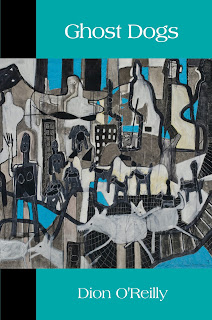
Dion O’Reilly’s prize-winning book, Ghost Dogs, was published in February 2020 by Terrapin Books. Her poems appear in Cincinnati Review, Poetry Daily, Narrative, The New Ohio Review, The Massachusetts Review, New Letters, Journal of American Poetry, Rattle, and The Sun. She is a member of The Hive Poetry Collective, which produces podcasts and radio shows, and she leads online workshops with poets from all over the United States and Canada.
www.dionoreilly.wordpress.com

Tuesday, February 15, 2022

Terrapin Book Interview Series: Geraldine Connolly Interviews Dion O'Reilly

The following is the third in a series of brief interviews in which one Terrapin poet interviews another Terrapin poet, one whose book was affected by the Pandemic. The purpose of these interviews is to draw some attention to these books which missed out on book launches and in-person readings.

Geraldine Connolly: What central themes haunted you in the writing of this book?

Dion O'Reilly: The mind grappling with a world full of both exquisite beauty and also unimaginable evil pervades Ghost Dogs. I seek to balance these stark elements almost in the way a painter balances light and dark in chiaroscuro. I believe such juxtaposition of supposed opposites ignites the lyric moment, an experience of deep connection with the Living World. So I guess I would say connection haunts the book—how to connect, which, I think, might be at the heart of  lyric poetry.

A motif that emerged is the way animals function as inspiration and solace. I knew I wanted my book to be called Ghost Dogs because the entire arc of the collection reflects a haunting—the past whispering in my ear. I grew up on a ranch, isolated and often in peril: mastiffs, horses, pigs, fish, and raptors were a solace, a source of wisdom. This animal motif emerged naturally because, on the ranch, I spent more time with animal-animals than human-animals. As I say in my poem “Rivervale,” Herons lifted their great bodies from the streambed,/ shining fish caught in their beaks,and the agony/ twisting in the air made sense.
 
Gerry: The California landscape is very vivid in your work. How does the landscape of your childhood inform the poems?

Dion: Well, as I say, I grew up (and still live part of the year) in a beautiful place—the Soquel Valley, on an eighteen acre ranch with two streams running through it. So I write what I know. Portraying connection with The Living World is a theme I borrow from eco-poetry, and just another way to engage the lyric moment of connection. A landscape is a self-portrait; a self portrait contains a world.

For some reason, as a child, I was able to pay attention to The Living World, and it lifted my thoughts to a different plane. That kind of focus was redemptive, and I’m grateful. It’s the same process when I write, paying attention helps me transform. For example, early in the book as a child, I watch the heron’s prey—the fish struggling—but as an adult I identify with raptors. I admire their hunger and their agency:

          The sun, a muzzle flash,
          turning the meadow bright, burning
          off the haze. I soar in, see it magnified,
          everything itself only more so.

Gerry: Can you tell us about your writing process?

Dion: The most important tool for me is reading regularly. Reading all sorts of poets. I start my day, preferably before sunrise, with reading poetry.

Other than that, I would say that really looking at my life is key to my process: Ghost Dogs contains stories I carried for decades. The difficulty was in seeing the narratives differently. For example, writing about my sister led me to express a new compassion for her. I struggle not to be the heroine of the tale, not to write revenge poems, not to reinforce tired grudges or viewpoints. If the poem does not create a connective moment of insight, it doesn’t satisfy me, doesn’t provide the poetry fix I seek. I guess that’s what we call discovery, which is often the hardest part of the process. But that moment of discovery might be what makes a poem a poem. It’s a thrill

But sometimes I wonder what discovery really is cognitively. It might be a  moment where, suddenly, I see my thoughts at work, almost like meditation, a meta moment where I catch myself identified with my thoughts, rise above, and connect with a different Self—a moment where I say, This isn’t the same old story. It’s a song. It’s a sonnet. It’s a chant. It’s a moment where I did wrong. It’s not what I thought it was. It’s not the voice in my head anymore. We all have voices in our head, from childhood, from middle school, from MFA workshops. I would hope my process sees these thoughts, these running inner dialogues, and transforms them. My poet mind is like a kind adult shaking my suffering, self-involved, or just blithely unaware self and saying Hey, things aren't what you think they are!!!

Nowadays, I work less from my old narratives and more from prompts, word lists, rhyme, and form. I think that's a common evolution for poets. Still, word lists and prompts often excavate memories related to those in Ghost Dogs, but they force me to express them differently.

That being said, I write about whatever obsesses me. Whatever voices are in my head! I love to give myself that freedom and permission. It’s a kind of self acceptance. I think of the painter Chagall who never stopped painting flying goats and Russian villages. All the paintings are different yet the same. I don’t care if I write about the same thing for the rest of my life. The magic of poetry is that it’s a portal to infinite perspectives.

Gerry:
Did you find it difficult to organize the book or did the poems fall easily into place?

Dion: Yes! I found it very difficult! Danusha Lameris, Ellen Bass, and Diane Lockward helped me organize Ghost Dogs. Ordering the book was its own discovery. I realized the poems traced my experience in a cohesive way I hadn’t seen before. The arc goes something like the following: reveling in the beauty of the Living World, the bad stuff that happened, the struggle that ensued, the redemption of adulthood.

Gerry: Do you think of yourself as a poet of the body? It seems that your work is so truthful about the body, both its suffering and its pleasures. Overcoming the suffering seems like a central concern, also you dare to write about the aging body in such a  frank and accepting way. I wonder how you came to this stance. Do you think of it as stoic?

It’s true my body has experienced extremes: the constant beatings as a child, enduring third-degree burns over most of my body, but life is beloved and joyous too with its many physical pleasures. I’ve had a lot of fun in my life and taken my body on many adventures! I just want to talk about it all. I don’t want to leave anything out. True sadness, for me, is to ignore part of my own experience.

I'm not afraid to talk anatomically about a woman's body, to break taboos or broach certain topics. I don’t understand why talking frankly about the aging female body, both its pleasures and its decay, is not a subject for polite company.

Maybe it’s because I grew up in such an isolated place, grew up in a barn as they say, I have always found it difficult to adhere to social conventions, so I’m just more open about my body. Dorianne Laux said of my writing, You're willing to say anything, and that can’t be taught. I agree, that at best, it’s difficult to teach a willingness to break silence. But whenever I read someone like Sharon Olds, Diane Seuss, Rachel McKibbon, Francesca Bell, Alexis Rhone Fancher, or Denise Duhamel, I see any subject is worthy of poetry. Singing the body electric has a long history in American poetry. It’s time for women to sing it too. Funny how people never stop being shocked yet intrigued by these violations of taboo. I guess that means we still need to talk about it.

I don’t know if I’m stoic. Maybe resilient is a better word. I think stoics suffer in silence, and I like to belt it out!


Sample poem from Dion’s Ghost Dogs:


Ghost Dogs  

Two hundred pounds apiece,
with strong bodies, great black heads,
and sad, sagging faces, they were my companions
through the long years of childhood.
Mastiffs. Herds of them—
studs, a handful of bitches, scores of puppies.
Bored, in dusty clumps, they guarded the driveway,
pulling themselves up
onto oversized padded feet
to trail my horse through the hills,
then—with surprising speed—racing
up deer trails in futile pursuit
of coyotes or bobcats.

My friends risked stitches in their thighs   
by knocking on the door,
and when the proud cars of boyfriends pulled up—
a gleaming ’68 Camaro, a convertible Bel Aire—
the pack ambushed them,
ferocious muzzles breathing steam,
drooling on the windows.

Now, all these years after leaving home,   
I miss the dogs,
how formidable they were,
negotiating between me
and the world. I have
no silent creature at my side
to touch on her wrinkled brow,
no coiled animal to summon,   
in love and ready to die.

Click for Amazon


Dion O’Reilly has lived most of her life on a small farm in the Santa Cruz Mountains of California. Her writing appears in such journals as The Massachusetts Review, New Letters, Sugar House Review, Rattle, and Bellingham Review. Her work has also appeared in a number of anthologies, including the Terrapin Books anthology A Constellation of Kisses. Her work has been nominated several times for a Pushcart Prize. An earlier version of Ghost Dogs was a finalist for the Catamaran Poetry Book Prize. She received her MFA from Pacific University. Ghost Dogs is her debut full-length collection.
website


Geraldine Connolly is the author of four full-length poetry collections: Food for the Winter (Purdue), Province of Fire (Iris Press), Hand of the Wind (Iris Press) and her latest book, Aileron, published by Terrapin Books in 2018. Her work has appeared in Poetry, The Georgia Review, Cortland Review, and Shenandoah. It has been anthologized in Poetry 180: A Poem a Day for American High School Students, Sweeping Beauty: Poems About Housework, and The Doll Collection. She has been awarded two fellowships from the National Endowment for the Arts. She has also received the Margaret Bridgman Fellowship of the Bread Loaf Writers Conference, a Maryland Arts Council fellowship, and the Yeats Society of New York Poetry Prize.
website


Related Posts Plugin for WordPress, Blogger...