Showing posts with label kissing the long face of the greyhound. Show all posts

Thursday, April 14, 2022

Terrapin Interview Series: Dion O'Reilly Interviews Yvonne Zipter


The following is the eleventh in a series of brief interviews in which one Terrapin poet interviews another Terrapin poet, one whose book was affected by the Pandemic. The purpose of these interviews is to draw some attention to books which missed out on book launches and in-person readings. Dion O'Reilly talks with Yvonne Zipter about discovery in poetry, dealing with difficult topics, poetry and religion, and finding solace in poetry.

Dion O’Reilly:
Nature, or what we now call The Living World, is a prominent feature in your poetry. Do you consider yourself an eco-poet?

Yvonne Zipter: I’ve never actually thought about it, but I think that’s a fair label to apply to my work. If ecopoetry explores “the relationship between nature and culture, language and perception,” as Forrest Gander posits in The Ecopoetry Anthology (eds. Ann Fisher-Wirth and Laura-Gray Street), then it makes perfect sense to apply that term to my work. Kissing the Long Face of the Greyhound, for instance, is organized roughly as a dialogue between the natural world and humans, the intent being to show how they—we—are interrelated. But I tend to agree with Naturalist Weekly that “labels can be challenging for readers and writers. They have a tendency to limit our ability to see the world. One of the things I really appreciate about poetry is that any given poem may produce different meanings to different people. . . . Any poetry that gets you to think about your role or place in the natural world is beneficial and . . . the labels we give them are only helpful if they contribute to the joy of the audience.” That said, I would be honored to be thought of as an ecopoet.

Dion: Do you strive to take turns in your poems, what we call voltas or peripeteia? In other words, do you seek a deeper layer, what Robert Frost called surprise and what many poets call discovery?

Yvonne: For me, part of the joy of writing poetry is discovering what the poem is about as I’m writing it. That surprise or discovery, to my way of thinking, is an important component of a compelling poem, not only for me as the poet but for the reader as well. The delight I feel when an out-of the-ordinary perspective emerges regarding some ordinary thing—I want the reader to feel that delight as well. A poem for which the significance of the subject remains opaque to me is never successful. I end up trying to force a revelation, and the resulting poem feels empty, too glib, uninspired—boring. What I aim for in my poems is being able to take the reader along with me in the process of seeing something in a new way that might ordinarily be taken for granted. Well, that’s not quite true—I write for myself, for the joy of learning something I knew but didn’t know I knew. It’s only afterward that I think about the reader.

Dion: How do you feel poetry should deal with what some call, perhaps unfairly, darkness—topics like death, pain, "the slings and arrow?"

Yvonne: Pain, death, and adversity are common to every living being and are thus topics that should be universally relatable. As a poet, writing about these difficult topics has not only given me solace but has also been a way for me to find beauty and/or poignancy about some of life’s least pleasant moments. The hope is that such poems can allow readers to think about their difficult moments in a new way and/or help them process their own pain or grief. At the very least, poems on topics such as these let people know they are not alone in what they’ve been through.


However, much as with love poems, poems about pain and death are hard to write without falling into abstractions and clichés. I often have to let months or years pass before I can write a poem about something dire that has happened before I can focus on the kinds of details that will let me tell the reader “this was awful” without telling them that.

Dion: You have a few poems which could be interpreted as having a theme of religion versus spirituality—"Still Waters" and "Manners of the Flesh" come to mind. Is this a theme you grapple with?

Yvonne: Religion, in my poems, functions as a sort of shorthand—like myth, in a way—to convey a lot about a subject without having to elaborate in great detail because the themes, terms, et cetera are well-known. I think of myself as a spiritual person. When it comes to traditional religion, I consider myself to be an atheist, but I was raised going to church (three different denominations, actually—Lutheran, Methodist, and Unitarian) and my wife is Catholic, so despite my beliefs, I am nevertheless steeped in this culture. But because I use religious imagery so often in my poems, my wife sometimes teases me that I’m the worst atheist ever. “Manners of the Flesh” was actually written for a friend of mine who has struggled with his own relationship to religion, especially during the time his sister was dying, hence the ambivalence about heaven, prayer, and so on, whereas in “Still Waters” I use the terminology of religion to express my reverence for nature and the awe I often feel in its presence—in other words, as a way to put spirituality on the same plane as religion.

Dion: Danusha Lameris talks about poets having a solace and an irritant. The irritant feels broken or off-kilter and inspires them to speak. But poets also often experience a solace, a relief from that irritant. It appears that the Living World (nature) and your dogs are a solace for you. Would you say that is true? And what is your irritant?

Yvonne: You’ve hit the nail right on the head: nature, including pets, is definitely a place of refuge for me. When I’m looking at a Cooper’s hawk in flight or hugging the dog, I’m not thinking about the precarious nature of our democracy or inequities of race and class. As a kid, I immersed myself in nature, haunting the nearby creek for frogs and garter snakes, climbing trees, and chasing bumblebees and fireflies trying to catch them in a jar so I could watch them up for a while close. But as I got older, I drifted away from the natural world. There was always so much else to do—studying, reading, learning what it was to be a feminist, to be queer. But as things began to slow down a bit, with a steady job and long-term relationship, I found myself drawn to nature again.
    

As for an irritant, I have a few, from racial inequities to political skulduggery. But these irritants overwhelm me in a way that, for the most part, makes it hard for me to write poetry about them without sounding shrill and prosaic. But then, that gives me something to work toward.


Sample poem from Kissing the Long Face of the Greyhound


Osteosarcoma: A Love Poem

          —for Easton, Zooey, and Nacho


Cancer loves the long bone,
the femur and the fibula,
the humerus and ulna,
the greyhound’s sleek physique,
a calumet, ribboned with fur
and eddies of dust churned to a smoke,
the sweet slenderness of that languorous
lick of calcium, like an ivory flute or a stalk
of  Spiegelau stemware, its bowl
bruised, for an eye blink, with burgundy,
a reed, a wand, the violin’s bow —
loves the generous line of  your lanky limbs,
the distance between points A and D,
epic as Western Avenue, which never seems to end
but then of course it does, emptying
its miles into the Cal-Sag Channel
that river of waste and sorrow.
I’ve begun a scrapbook:
here the limp that started it all, here
your scream when the shoulder bone broke,
here that walk to the water dish,
your leg trailing like a length
of   black bunting. And here the words I whispered
when your ears lay like spent milkweed pods
on that beautiful silky head:
Run. Run, my boy-o,
in that madcap zigzag,
unzipping the air.

Click Cover for Amazon

Yvonne Zipter was born in Milwaukee, WI, and following sojourns on both coasts, has replanted herself firmly again in the Midwest. She lives in Chicago with her wife and a long succession of retired racing greyhounds. She is the author of the poetry collections Kissing the Long Face of the Greyhound, The Patience of Metal (a Lambda Literary Awards finalist) and Like Some Bookie God; the nonfiction books Ransacking the Closet and Diamonds Are a Dyke's Best Friend; the novel Infraction; and the nationally syndicated column "Inside Out,"which ran from 1983 to 1993. Her poems have been published widely in periodicals.
www.yvonne-zipter.com

Dion O’Reilly’s prize-winning book, Ghost Dogs, was published in February 2020 by Terrapin Books. Her poems appear in Cincinnati Review, Poetry Daily, Narrative, The New Ohio Review, The Massachusetts Review, New Letters, Journal of American Poetry, Rattle, and The Sun. She is a member of The Hive Poetry Collective, which produces podcasts and radio shows, and she leads online workshops with poets from all over the United States and Canada.
www.dionoreilly.wordpress.com

Thursday, January 27, 2022

Terrapin Books Interview Series: Yvonne Zipter Interviews Heather Swan

I've been feeling bad for poets whose books were released during the Pandemic, poets whose book launches were cancelled or never scheduled, poets who haven't been able to do in-person readings. I asked myself, Aside from buying lots of books, what could I do, especially for my own Terrapin poets? So I devised an idea for an interview series. I invited all of my Terrapin poets to select one poet whose book had come out during the Pandemic. They were invited to choose a poet whose book they'd read or wanted to read and then to come up with five questions for that poet to respond to. The response was wonderful! Thirteen poets offered to do a Q&A. Some of these were poets with a Pandemic book themselves but some were poets without a Pandemic book. Lots of generosity among my poets! Yvonne Zipter was the first Terrapin poet to volunteer; she chose to interview Heather Swan about her Terrapin book A Kinship with Ash.

Yvonne was also the first poet to complete her interview. Here is that Q&A.

Yvonne: With both of your parents artists—your father a painter, your mother a potter—were there ways that being surrounded by art influenced your work as a writer, in particular your poetry?

Heather: Growing up in studios with people who turned ideas into images made of paint and clay certainly affected me. I understood metaphor and the importance of art so intrinsically, it never occurred to me that others did not understand the world in that way. My life was filled with art and music and stories. My mother's craft required so much (literal) centering and concentration as well as trust in the process, like writing poems does. Everyone around me made things in order to make sense of our world or to comment on it. I learned to make pottery and sculpt and paint, but I also wrote everything down. I recorded images and thoughts in journals as a child. My writing now is filled with visual imagery and, I hope, layers of meaning that one could discover in a painting.

Yvonne: Your love of nature is evident throughout A Kinship with Ash. Have you always loved nature? From where does this appreciation spring?

Heather: I feel like I have always been a part of the natural world. I spent so much of my time outside as a little girl. The studios where my mother and father worked were luckily near spaces I could explore with my dog. I moved from the prairies and woodlands of the Midwest to Colorado where I lived in the mountains. Later we moved again to a town on the east coast by the ocean. Because I moved so often, my human friendships didn't last long, but my dog was a constant companion with whom I explored these landscapes and this allowed a deep connection to the birds, the insects, and the land. All the beings we encountered in those spaces led interesting and important lives and spoke in languages I didn't understand, but recognized as valuable and mysterious.

Yvonne: A number of the poems in this collection grapple with the effects of pesticides and climate change. They are all both heartbreaking and beautiful. What does writing such poems afford you?

Heather: The experience of loving this beautiful, fragile, miraculous planet at this historical moment also means being in touch with enormous grief as so many species are going extinct, as forest after forest is being killed, as fish are struggling to survive in toxic waters, as frogs and insects are disappearing. When I write, it is part elegy, part plea. When I write, I want to remember that while so much is being lost there is also so much to be grateful for. I hope that my poems are an invitation to readers to pay attention to the outrageous beauty and vast number of different intelligences out there as well as to question our impact on the world.

Yvonne: Your sweet motherhood poems also showcase your love of nature. My sense is that this entwining is part of what fuels your anxiety about the state of our world. Can you elaborate on this?

Heather: Funny, this question made me tear up. Yes, of course. I am a parent and a teacher. My children have grown up on trails, in trees, in canoes spotting birds, insects, and frogs. A part of their community. They ache knowing so much of what they love is at risk. I invite my students to connect with each other and the planet, so they will be invested in the work of care. I think all the time about the next generations. Will polar bears still exist? Will the oldest trees survive? Will the coral reef thrive? I want so much to be a responsible ancestor, not just to my children, but to all humans and non-humans. I would like my work to offer an invitation to intimacy with the earth and also hope that we can change things for the better.

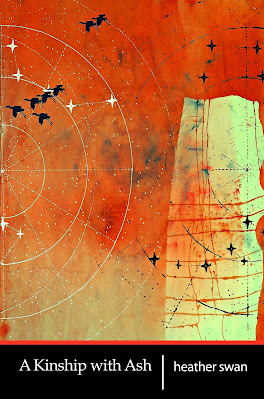
Yvonne: The cover of your book is beautiful and evocative, with various ways to interpret its relationship to the book. Can you discuss the genesis of this piece of art becoming your cover and how it illuminates the poems within?

Heather:
Emily Arthur and I met when we served together on a panel on Earth Day that basically asked what art is saying about the planet right now. Emily's work immediately seized my attention. Her prints depict ghost landscapes, places of cultural and natural erasure, while also serving to honor and revive the missing stories of her Cherokee ancestors. For a variety of reasons, these images exploring loss and survival after great violence resonated with me, on both a personal and global level. When I completed my manuscript, I knew that I wanted to ask Emily if I could use her work on the cover. I am so honored she said yes. The colors of the print on the cover hint at heat and ash as birds migrate across the image with the help of the stars. But how has their home changed? Is there still a home? Emily Arthur's sense of home is complicated by the removal of her people and the species eradicated by this process. Her work, I think, holds both sorrow and strength. I hope my poems, too, can allow someone to feel the loss, but also to remember the beauty and the hope there still is for renewal and recovery.

                                                             Click Cover for Amazon


Sample poem from Heather's book:


Rabbit

After a long numbness, I wake
and suddenly am noticing everything,
all of it piercing me with its beautiful,
radical trust: the carpenter bee tonguing
the needle of echinacea believing
in their sweetness, the exuberance
of an orange daylily unfolding itself
at the edge of the street, and the way
the moss knows the stone, and the stone
accepts its trespass, and the way the dog
on his leash turns to see if I’m holding on,
certain I know where to go. And the way
the baby rabbit—whose trembling ears
are the most delicate cups—trusts me,
because I pried the same dog’s jaw
off his hips, and then allows me to feed him
clover when his back legs no longer work,
forcing me to think about forgiveness
and those I need to forgive, and to hope
I am forgiven, and that just maybe
I can forgive myself. This unstoppable,
excruciating tenderness everywhere inviting
us, always inviting. And then later, the firefly
illuminating the lantern of its body,
like us, each time we laugh.


Heather Swan is a poet, nonfiction writer, and teacher. Her chapbook The Edge of Damage won the Wisconsin Fellowship of Poets Award. Her poetry has appeared in journals such as Poet Lore, Cold Mountain Review, Phoebe, The Raleigh Review, and Midwestern Gothic. Her nonfiction has appeared in Aeon, Belt Magazine, Catapult, Edge Effects, ISLE, and Minding Nature. Her book Where Honeybees Thrive: Stories from the Field won the Sigurd F. Olson Nature Writing Award. She has been the recipient of an Illinois Arts Council Poetry Fellowship Award, the Martha Meier Renk Fellowship, and the August Derleth Award for Poetry. She teaches writing and environmental literature at the University of Wisconsin-Madison, and she is a beekeeper.


Yvonne Zipter is the author of the poetry collections Kissing the Long Face of the Greyhound (Terrapin Books, 2020), The Patience of Metal (a Lambda Literary Award Finalist), and Like Some Bookie God. Her poems have appeared in numerous periodicals, including Poetry, Southern Humanities Review,  Bellingham Review, and Spoon River Poetry Review. Her published poems are currently being sold individually in two vending machines in Chicago to raise money for the nonprofit arts organization Arts Alive Chicago. She is also the author of the Russian historical novel, Infraction (Rattling Good Yarns Press, 2021) and the nonfiction books Diamonds Are a Dyke’s Best Friend and Ransacking the Closet. She is retired from the University of Chicago Press, where she was a manuscript editor.

Please visit the Terrapin Bookstore for these and other Terrapin Books.


Related Posts Plugin for WordPress, Blogger...