Throughout this month I'll be posting poetry books that I have bought, read, and admired—and that I now recommend to you. Poets need support. Nothing lifts the heart of a poet more than a book purchase by a new or returning reader. Keep in mind as you juggle pennies that a poetry book is one of the best bargains around. Let's say a book has 40 poems in it and sells for $16. That means you're getting each of those poems for a mere forty cents! The poet labored over each one of those poems, probably spending days, weeks, months on each one. Each one of those poems can be read and enjoyed over and over. So this month treat yourself to some wonderful books and, at the same time, make a poet happy.
Patricia Fargnoli Winter (Hobblebush Books)
Second Place for the Julie Suk Book Award
Click Cover for Amazon
Open this book, and you will find "a blind woman / who tells us / the dreams of the blind." You will sense the snow in your hands and the "scent of raspberries and lime, / a wooden chair rocking." You will see a man who "stands in a salt marsh up to his knees in the black water" and "some stranger waving to another stranger, / waving." Who are these strangers, reader, if not ourselves? Patricia Fargnoli loves this delicacy of suggestion, tells us the dreams of the blind, which are perhaps our own, tells us of the natural world, which around us is vanishing. This is a book where, "before all the bridges have burned / the cows will come home." Yes, for those who wait "Cometh the hour, cometh the cows." And so, "in the silence of horses," one perhaps, hears one s own voice more clearly. And then come "blind horses" with the naked woman, and also "six white horses eating gray sky" and "the horses rear and bolt with the wide-eyed children." This is a bestiary of the spirit.
—Ilya Kaminsky
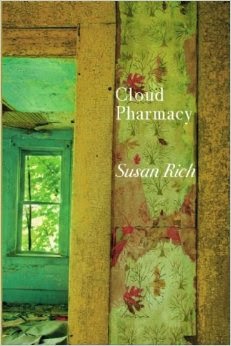
In Cloud Pharmacy, Susan Rich transforms unease into beauty--sensual and marvelously conflicted poems of romantic love, memory, and identity. These poems weigh gorgeous evidence but never offer simple decisions. The recurring image of a wildfire never lets them rest. In a central sequence of original poems, Rich explores 19th century photographer Hannah Maynard's images, looking in grief-heavy places for revelation. The result is wonderfully strange and unsettling; this is Rich's most haunting collection yet.
—Kathleen Flenniken
Kathryn Stripling Byer Descent (Louisiana State University Press)
Recipient of the SIBA award
Recipient of the Roanoke Chowan Award
Click Cover for Amazon
From the glorious opening poem, the mourning sound of the morning train weaves through Kathryn Stripling Byer’s new collection, as much a part of the hills of home as are its sins and beauties. Oh, the longing to shed forever what we are and what made us, at the same time hugging the litany to us that brings it all back: Cullowhee Creek, Buzzards Roost, hay bales, blackberries, grandmother’s gladiolas and lace doilies, and the earth that knew us better than we knew ourselves. Such longing in these pages, such hunger, such "grabbing at air."
—Alice Friman
Julie L. Moore Particular Scandals (Cascade Books)
Click Cover for Amazon
These are poems that span our daily lives and ask the hard metaphysical and theological questions living brings. . . . They are alert (without sentimentality or false transcendence) to the grace and beauty, both ordinary and commonplace, that open our hearts and mouths in hallelujah. I so admire these poems that quietly refrain from false claims and extravagances, but patiently bring us—in their detailed evocations—closer to [our] paradoxical and mysterious lives.
—Robert Cording
I am pleased to have Susan Rich as the featured poet in The Poet on the Poem.
Susan Rich is the author of four collections of poetry, most recently Cloud Pharmacy. Her earlier books are The Alchemist’s Kitchen, named a finalist for the Foreword Prize and the Washington State Book Award, Cures Include Travel, and The Cartographer’s Tongue, winner of the PEN USA Award for Poetry and the Peace Corps Writers Award. Susan has received awards and fellowships from Artist Trust, CityArtists, 4Culture, The Times Literary Supplement of London, Peace Corps Writers and the Fulbright Foundation. Her poems have appeared in the Harvard Review, New England Review, and The Southern Review. She lives in Seattle and teaches at Highline Community College.
Today's poem comes from Susan's new book, Cloud Pharmacy.
There are days made entirely of dust
months of counter-winds
and years unbalanced on the windowsill.
The soup poured in the same yellowed cup.
Newspapers appeared like oracles on your doorstep—
glamorous fragments of anonymous love.
You stayed in bed, read novels, drank too much.
God visited, delivered ice cream; returned your delinquent library books.
Is it simpler after you’re dead
to watch the living like characters on an old-fashioned TV set?
The dying are such acrobats—
You see them ringing doorbells with their clipboards
remarking on the globes of lilacs.
They try to lure you out; request a drink of water,
some blue grapes. This does not work.
Then the dying leave you to yourself—
to the girl dressed in black, suffused with commas,
and question marks—
How to write your one blue life?
DL: I’m intrigued by the form of your poem. You alternate 2-line and 1-line stanzas. Then you also alternate lines that are flush to the left margin with lines that are indented several spaces. How did you arrive at this form?
SR: I believe this poem needs the freedom to move across the page; it needs to wander.
My reason for the indentations and alterations is that for me, and perhaps for my readers, the oddness of the subject—God delivering ice cream, for example—is best represented with a physical shape that quietly signals a slightly different type of poem, different let’s say, than straight narrative. Or perhaps my reason for this choice is as simple as this: when I open a journal, my eye is immediately attracted to the poems that frame white space in startling ways.
In my collection, Cloud Pharmacy, I try out different forms for different types of poems. With “Blue Grapes,” which introduces the book, I wanted to explore an interior, surreal, landscape of loss. This unreliable, yet definite pattern emerged. At first, I was afraid that this wasn’t a poem. It arrived in fragments and I was unclear about how the parts would fit together.
I write the first few drafts of a poem in red notebooks with graph paper. My process is often very messy—this form was my way of trying to honor the messiness of thought.
DL: Punctuation seems important in this poem. You violate Richard Hugo’s prohibition against the semi-colon, you pepper the poem with em dashes, in the penultimate stanza you make reference to “commas, / and question marks,” and you include two questions. Tell us your thoughts about the role of punctuation in the poem.
SR: When I was in elementary school in Brookline, Massachusetts, in the late 1960’s, there was little emphasis placed on correct punctuation; instead, the teachers encouraged full expression. Students chose which books we wanted to read for our curriculum and created our own poetry anthologies. Fortunately or unfortunately, this means that since I did not learn the hard and fast rules of punctuation when I was young, I sometimes get into trouble when I am writing. It also means my ideas on punctuation remain fluid.
And yes, I do have a great fondness for the em dash. I’m amazed that it isn’t used more in poetry. Punctuation, like poetry, remains a bit like magic to me. So often poets seem to let go of punctuation in their poems. I prefer to use different punctuation marks for my own strange purposes. I recall Denise Levertov’s strict guidelines for how long to pause after a comma and how long to stop at the end of a line. Many of Levertov's poems were set to music, yet she was never satisfied with the scores; they didn't equate with the music she heard in her head. I offer this by way of explanation. I want to use punctuation to score the poems, to make them equate with the music inside my head.
DL: There’s a surreal element in the poem. You give us “years unbalanced on the windowsill,” newspapers that appeared “like oracles on your doorstep,” and a God who “visited, delivered ice cream; returned your delinquent library books.” How do you achieve these dream-like moments? How hard is it to trust them, to allow them into the poem?
SR: Wow, I love this question, but I want to first turn it around. The dreamlike moments are the core of the poem; they are the force of the vision I’m trying to express. I think of Elizabeth Bishop saying that what she wants while reading a poem is “to see the mind in motion.” My mind goes to the odd and the unlikely. I’ve always been interested in the juxtaposition of the quiet of morning coffee with the news of the world. As a child the unfolding of the newspaper from itself taught me that the world was out there waiting for me to try to understand it.
Now to answer your question more directly: these “dream-like” moments come easily to me; they are the way my mind works, the way I understand the world. I find no tonal separation between the line “you stayed in bed, read novels, drank too much” and the next line “God visited, delivered ice cream; returned your delinquent library books.” In fact, I do not drink alcohol, so that first line seems more preposterous to me. Poetry works as an avenue of presences, a way to live in the world that exists beyond what we can actually know.
DL: The poem includes a line borrowed from poet Deborah Digges: “The dying are such acrobats.” The line appears just beyond the mid-point, but was it the impetus for the poem? Did it ever appear earlier in the poem? Talk about its influence on the poem.
SR: Sometimes when I write, I find myself losing interest in a poem long before it’s done—and certainly I do abandon poems. I’m pretty ruthless when it comes to tossing out work. Other times, there’s something that I’m caught on—I’m not ready to call it quits, but I don’t know where the next handhold is hiding.
In “Blue Grapes” I used Deborah Digges’ line to catapult myself back into the work. I was reading and re-reading her book Trapeze at the time. The line arrived in the middle of the process. I think of it as the hinge pin to the poem. I worry a little that my favorite line in my poem is not mine at all. And then I remember that most useful quote by T.S. Elliott, “Immature poets imitate, mature poets steal; bad poets deface what they take, and good poets make it into something better, or at least something different.”
I love the sense that I’m able, through my poems, to have a conversation with the poets I admire, especially those who are now deceased. Shortly before I wrote “Blue Grapes,” a friend introduced me to the work of Deborah Digges and I became immediately transfixed. Her work gave me permission to try many different approaches to a poem all at once. I hear her voice as strongly lyrical interspersed with the vulnerability of grief. In a sense, I needed a bit of bravery to continue on with this poem and her line helped me find it.
DL: Beginning with the title, “Blue Grapes,” colors play a role in the poem. There’s also a “yellowed cup,” “lilacs,” a “girl dressed in black,” and finally, the “one blue life.” The poem has the feel of a still life painting. Tell us how and why you painted in the colors.
SR: I was deep into studying ekphrastic poetry when I wrote this. An emphasis on composition found its way into this piece from the work I was doing on 19th-century women photographers. Another major influence on my poetry is that I teach film studies. I’m constantly asking my students to think in images and symbols, to focus on what is seen.
The irony is that I don’t see this poem as colorful or even very cinematic. And yet I can’t disagree with you. You’ve certainly provided solid evidence to prove me wrong! I think my blindness to the poem's colors has more to do with my own understanding of the poem as coming from a supremely interior world. This particular poem felt hard-won. I’m not writing about an event or an easily identifiable feeling here. Instead, I’m trying to pry open my own sense of consciousness. What does it mean to live as a “self”?
I’m not one to write about my own life and this speaker is not me. However, I am very fond of ice cream.
********************
Readers, please listen to Susan reading her poem, "Blue Grapes," from Cloud Pharmacy.
It is my pleasure to host a poetry salon for Susan Rich whose latest book, The Alchemist's Kitchen, was recently released by White Pine Press. Ideally, I'd like to have this party in my home, but since I live in New Jersey and Susan lives in Seattle, that's not possible. I've known Susan for several years on the Wompo listserv. Then we met in the fall of 2007 when we both read at the Burlington Book Festival in Vermont. We met again later that same year at AWP in New York.
Everyone, please get comfortable and let's hear what Susan has to say about her new collection.
Diane: You have two previous collections. Is this new one a continuation of or a departure from those books? What's familiar, what's new?
Susan: I think The Alchemist’s Kitchen is a departure in a number of ways. This is my first time composing poems out of history, out of visual art, out of what it means to be living in middle life. My past two books, Cures Include Travel and The Cartographer's Tongue, focus more on the external world, the poems located in the different countries I’ve worked in: Bosnia, Palestine, Republic of Niger, and South Africa. And although I still love to travel, I’ve now claimed a more permanent geography in the Pacific Northwest. In fact, this summer the anthology New Poets of the West, comes out and it includes two of my poems. So although I grew up in Massachusetts and lived there until my mid-30’s, I am now officially a “new poet of the west.” This makes me ridiculously happy.
More importantly, perhaps, is that The Alchemist’s Kitchen is my most ambitious book. Dealing with my mortality isn’t easy, let alone writing about it. There are many poems in The Alchemist’s Kitchen that I didn’t want to write. For example, the third section of the book focuses on the strangeness of aging with poems like “The [In] Visible Architecture of Existence,” “Letter to the End of the Year” and “Curating My Death.” Perhaps because I passionately did not want to write these poems, they seem to have an extra sense of urgency about them. My personal sense of privacy and decorum lost. The poems won.
This is also true of the poems concerning the life and art of Northwest photographer Myra Albert Wiggins (1869-1956). Drawing inspiration from the visual arts always seemed a little too hoity-toity to me. I began writing the Wiggins poems as a challenge to myself. Could I focus on a historical artist, one that is all but lost to history (the way I may someday be) and re-infuse her work with life? I acquainted myself with her husband and her daughter, her trips to Paris and Jerusalem. By the end of two years, I felt I knew Myra better than I know myself.
Getting back to your question, some things stay the same, of course: attention to cadence, image, and surprise. I’m constantly trying to push forward in these areas. I hope I’ve succeeded, but that’s for my reader to decide.
Diane: Tell us the story behind your cover.
Susan: I think we need an all weekend party for this story! The cover comes from a photograph by the German photographer, Phillip Schumacher, whom I met last summer at an artist residency in Spain. Phillip creates what he calls “one shot films” which means his pictures usually include a broken narrative, an unexpected situation and sometimes a detail of the absurd. The kitchen pictured is located in the Villa Hugel, the family home of the German Industrialist, Alfred Krupp, which is now a famous museum. I hadn’t expected to use a literal kitchen on the cover, but I fell in love with the pans illuminated in a lilac glow, the door within a door, and the overall film noir atmosphere of the image. Plus, I loved featuring the work of Phillip, a photographer whose work I admire so much. Phillip is only at the beginning of a very successful career and it’s an honor to introduce his work to North American audiences. One more thing: the cover only features 1/3 of a very large image which includes a life-size plastic stag, an angry chef, and an oven. Interested guests can visit my blog to see the the photograph in its entirety.
Diane: Why did you title the book The Alchemist's Kitchen?
Susan: The title of this collection came to me far more easily than the titles of either of my past books. I was re-reading Denise Levertov’s New and Selected Essays—many of which were written, I believe, during her time in Seattle. In her essay "Biography and the Poet" (1992), Levertov takes up the question of literary biography of poets (and by extension, she expands, all biographies) as to whether we need to know about the drugs and dalliances of the poets’ lives or if they are “the chaff which the imagination has discarded.” For the most part, she rallies against being too inquisitive regarding the facts of the writing life. But the essay is balanced with praise for certain biographies such as Walter Jackson Bates' Life of Keats, where the biography is in service to the poems or to essays or journal pages some poets had published. Sometimes, Levertov says, while understanding the life of the poet, “one is grateful for a glimpse into the alchemist’s kitchen.” I immediately felt myself drawn to the phrase.
I’ve re-interpreted Levertov’s original sense of looking at a poet’s memoir or biography being the alchemist’s kitchen to the poems themselves being the material of alchemy—the ordinary objects turned to gold. In researching more on the nature of alchemist—in its original meaning—I learned that Alchemy has a double origin in Greek philosophy and Egyptian texts. The origin of the word itself is thought to be Arabic. But what fascinated me the most was that the alchemists were not merely interested in turning base metals into gold but were also in pursuit of spiritual discipline and that the transformation of metals was secondary to the wisdom that the alchemist would himself attain through his work. One of my favorite quotes by the poet Stanley Kunitz goes like this: “The first task of the poet is to create the person who will write the poems.” So to answer your question, I’ve used the term “alchemist’s kitchen” as a metaphor for the process of writing poems. That said, I also am a great lover of food — growing it, preparing it, bringing friends together to enjoy it.
Diane: What do you hope readers will take away from your book?
Susan: Joy. Wisdom. Entertainment. A hearty appetite for the power of poetry to transform our everyday existence into something better—a way to make sense of the incongruities of our lives. As a reader, when I pick up a poetry book, I yearn to be surprised, to find words that teach me about my interior life, that make me want to read a poem or a line over, and over again. My hope is that I’ve created such an experience for other readers—or at the very least—made them hungry for “a praline heart” or “Spanish torte.”
Diane: Please choose a favorite poem for us and, if you like, tell us why you chose this one.
Rental
I’m afraid to own a body, you said
the regressive tax on breast and thigh
would be too high; then you circled
my wrists, held them brightly
and I registered in your eyes, the look
I imagine of accountant or old paleontologist
appraising semiprecious finds.
When you pose me toward the light
and we touch, you take
a transparency with your eyes;
as if April evenings can be
known things, as if
our rental car agreement
extended to tongues and only then
under certain conditions
to wondrous singing.
Praise song for contracts signed
in pocket parks where we
descend with little savings—Bless
even the promissory note
reneged, the unreality of love’s
retreating. Your voice remaining
a little distant, but still companionable
like the announcer on late night radio—
Susan: I chose “Rental” because it is a poem I most definitely did not wish to write. It was the first poem I finished last summer while I was in residence at Fundacion Valparaiso. A relationship that I had been involved in in Seattle had ended abruptly and the last thing I wanted to do was wallow in those knife wounds of heartbreak. There I was in Andalusia, on the shore of the Mediterranean, and yet memory kept interfering with the sun. Until I wrote this poem, no others would show up. Not surprisingly, once I finished “Rental” it became easier to move on to new work. And somehow, in spite of how much I didn’t want to write this poem, I’ve ended up liking it very much. I especially appreciate the ending which tries to name that odd sensation of hearing the ex-lover’s voice—the same voice that uttered love cries during the relationship—speak in the aftermath. Poetry works in a myriad of exasperating ways. How lucky I feel to be a poet in this life. Sometimes I need to remember how much I wanted to be a writer from the time I learned how to read. And here we are—living the writing life—having drinks and even ice cream in the blogosphere.
Now comes the best part of our salon. We get a chance to hear Susan read her poem, "At Middle-Life: A Romance."
What's a party without something delicious to eat? Please help yourselves to a parfait, some cookies, fresh fruit, and cold fruit punch.
Overheard at the party:
"These are poems of praise and wonder graced by a delicate touch."—Brian Turner
“Don't read Susan Rich’s latest book on an empty stomach. Although The Alchemist’s Kitchen contains a wide, intelligent, and thought-provoking variety of poems, it does food better than most of the restaurants I’ve been in.”—Mark Brazaitis, Peace Corps Worldwide
Be sure to pick up a copy of Susan's book. Then while you enjoy your snacks, please feel free to ask Susan some questions. Leave them in the Comment section. Susan has promised to respond. And thanks for coming to the salon.
I've recently been lucky enough to have a friend who hosted a poetry salon for me at her home. The purpose of the salon was to celebrate the publication of my new book. It was a special day and a wonderful way to spend time with friends talking about the book, reading some of the poems, socializing, snacking, and signing.
After the party, I set my brain to figuring out a way that I could celebrate the books of poets I know who live too far away to invite to a salon at my home but whose work I admire. So I have invented the online version of the poetry salon. A poet with a fairly new book will be hosted, he or she will talk to us about the book, we will hear the poet read a poem, food will be plentiful, and there will be good conversation.
My debut salon will be for Susan Rich and her new book, The Alchemist's Kitchen. Look for it tomorrow. You're all invited!