Showing posts with label Poet on the Poem. Show all posts

Wednesday, April 20, 2016

The Poet on the Poem: Ginger Murchison


I am pleased to feature Ginger Murchison in The Poet on the Poem.


Ginger Murchison earned her MFA from Warren Wilson College. Together with Thomas Lux, she helped found Poetry at Tech, where she served as associate director for five years and since as one of its visiting McEver Chairs in Poetry. She is a member of the Board of Trustees of The Frost Place,
a member of the conference faculty for the Palm Beach Poetry Festival, a regular guest at the Bread Loaf Writers’Conference, and Editor-in-Chief of the acclaimed The Cortland Review. She lives in Ft. Myers, Florida.


Today's poem comes from Ginger's book, a scrap of linen, a bone.

Click Cover for Amazon


Roller Coaster

          
It starts with the climbing in,
nerved-up enough
for that defiance
of gravity, the slow-grind                          
rackety-clack one-inch cog                         
at a time—the mystery of machinery,
the sane and safe weightedness
of stiff-starched values,       
wondering if there were                          
sins we committed               
since our last confession, then               
at the top, out on the edge,
beyond the solid-ground world                            
parents live in, we test life,                        
theirs and our own, up where            
we are a hole in the sky,                     
wholly abandoned in the eyes-
shut, heart-stopped drop,
like lawlessness on falling‘s
crisp speed, the first curve, a blur,                                     
the world’s suddenness,                                                     
metal, air and a prayer
half-mouthed, spun,
flung into another plunge,
a curve swerving,
a tiny boat in a tempest—                                                                                                  
and isn’t this how we want                    
to live, live higher up,                                                                                                          
hungry to leave the ground,
flinging sparks, the lights brighter,
the dark darker, bodies at war                               
with mere air, but still obedient
to the tracks laid down
to keep us on track.     


DL: Your poem is as thrilling as the ride it describes. I think that the intensity and energy have something to do with the shape of the poem. Talk to us about that. Why the long skinny format?

GM: I wanted the poem to feel like that ride. I settled on the short lines from the beginning because, first, I wanted the poem to look like a roller coaster, but beyond that, I wanted the reader, at the end of each line, jerked forward by the poem’s enjambments to the beginning of the next line in the same way riders are jerked side to side throughout a ride. Enjambments (line endings at a place other than a natural grammatical pause) can occur more frequently when the lines are very short, and because enjambments make the line work against the sentence, they actually create a subtle physical discomfort in the reader. At an enjambment, the reader stands at the end of the line with one foot in the air and nowhere to put it down. Off-balance, he’s seeking completion of the grammatical thought, so he’s compelled forward to the next line, then immediately, he’s at that unsettling place again. The reader’s movement through the poem is intended to mimic how we are tossed around on a roller coaster. The enjambment is a marvelous device in any poem where you don’t want the reader comfortable.
 
DL: Your poem consists of one long sentence. What Is the intention behind this strategy? What do you think the single sentence adds that a series of sentences might lose?

GM: Remember how a roller coaster eases out at the beginning, then inches up the long incline, and we’re holding our breath in anticipation? We don’t hold our breath because we don’t know what’s going to happen. We hold it because we know precisely what’s coming, and we’re breathlessly waiting for the thrill of that drop. Once it comes, the whole ride is over in mere seconds. There’s no stopping along the way, no place for breathing. In the same way, a one-sentence poem leaves the reader breathless at the end. “The Double Play,” by Robert Wallace, is a one-sentence poem I’ve taught for years. Visualize that single fluid movement of the 5 players involved in the double play. Wallace’s poem uses grammar to enact that exactly. My college baseball players are surprised at the fluidity in that poem—how the ball moves forward player to player without the slightest hesitation in the telling. Only a single sentence could do that in the same way that only a single sentence could describe that roller coaster ride. Grammar, if you let it, does a lot of the heavy lifting in a poem. 

DL: You use a lot of hyphenated words, sometimes singly as in “nerved-up,” “stiff-starched,” and “solid-ground.” Other times you have hyphenated words in a row, e.g., “slow-grind rackety-clack one-inch cog” or “eyes-shut, heart-stopped drop.” How did you land on this technique? Why employ it?

GM: I remember how, standing in line, we’d work up the courage to actually get on the roller coaster. “Nerved-up” seemed a good way to say that, and sometime later I added "enough." I liked the “uh-uh” that carried its own ambivalence. As the roller coaster made its “slow-grind” to the top, I wanted the reader to hear and feel that nerve-wracking “rackety-clack” that the chain lift made on the way to the top. I looked for words I could hitch together the way the cars were hitched together. A few lines later when we’re “a hole in the sky / wholly abandoned,” I wanted to initiate speed exactly where the roller coaster plunges into the “eyes-shut, heart-stopped drop.” It's almost impossible, reading aloud, not to feel yourself speed up at that point. “Eyes-shut, heart-stopped drop” reads faster with the hyphens than without, and the enjambments contribute to hurtling the reader forward. Even the smallest detail can add something fairly dramatic to a poem. We should pay attention to every opportunity our poem offers.  

DL: You use a variety of devices of sound which make the poem a joy to read aloud. Among these devices are the following:

            a. Internal rhyme, e.g., “a curve,” “a blur,” and “a curve swerving”; “air” and “prayer”; “flung” and “plunge.”
            b. Words contained within other words, such as “sins” and “since”; “hole” and “wholly”; “dark” and “darker.”
            c. Alliteration, e.g., “sane,” “safe,” “stiff-starched”; “tiny” and “tempest”; “committed” and “confession.”

Please comment on your use of devices of sound. Did they emerge intuitively or were they sought after? At what point in your drafting, did they appear? What role did they play in revision?

GM: Thomas Lux taught the first poetry workshop I took. He said then and still says that poems are “made things,” so it’s not far-fetched that those Georgia Tech engineers can make poems out of the same attentiveness they’d pay to making a bridge. I love that poetry is a craft, and I love its devices. That internal rhyme you point to, stacked as it is into that curve, hopes to keep up the speed and make the reader feel a bit tossed side to side as the poem flings those blended sounds right then left. We are good readers. Our eye notices the “ur” in “curve” and “blur” before we get there. Then those internal rhymes pile up, and at “air,” the eye’s already moved on to “prayer,” registering that sound even before it’s spoken. Then “spun” starts that rolling “un - un - un” that gets “flung” right in the face of “ur - ur” at “curve swerving.” Notice how fast we’re moving through the poem at this point? The internal rhymes push the speed into the “blur” of the “curve swerving,” and the poem has its own kind of centrifugal force, and it's a felt force.

“Sins” and “since” appear at that most vulnerable short-vowel sucked-in-breath moment right at the top where “we are a hole in the sky, / wholly abandoned,” a long-O moment, producing an appropriate “oh-oh.” “Dark darker” just aimed, like “lights brighter,” for the intensification of sensation—exactly what the roller coaster symbolized. 


I’m more likely to think about alliteration in revision. I’m guessing “stiff-starched” or an equivalent has popped into more than one poem of mine. I went to Catholic school, where I got an A+ education. I learned to love words and loved playing with how hard and soft sounds changed things, how changing a sentence's rhythm got different results. I got my grammar there, too, but in some respects, it was a “stiff-starched” world. I didn’t give myself permission to write a poem until I had quit teaching and had my “other work” done.

DL: Towards the end of the poem you have a kind of turn line: “and isn’t this how we want / to live…” which moves the poem into metaphor. What was the original goal of the poem? At what point did you know you were going to transition into the metaphorical?

GM: "Roller Coaster" was born out of a conversation with some high-school buddies reflecting on our memories of Joyland, an amusement park in Wichita, Kansas. I found a YouTube video of the supposed last ride on that roller coaster, and I watched it dozens of times. I wanted to put that roller coaster back in action for my classmates, to recreate the sensations we remembered. The devices we’ve talked about here helped me with that, but the transition you noticed showed up for me, first, in that “out on the edge” moment, “beyond the solid-ground world / parents live in.” It was at that peak of the poem’s and my experience that the roller coaster became a vehicle of my moving beyond them, so you’re exactly right. That plunge led directly into a metaphorical turn, and that’s where the surprise was for me—how all the poetic devices stop at exactly that spot, how the poem slows down, how that roller coaster, a metaphor for my own sense of self, could “leave the ground / flinging sparks….at war with mere air” and yet not break any of the laws of physics and mechanics that kept it on track. That’s said, in some way, in many of my poems. I was part of that generation of women for whom objects like the roller coaster, like the river, like a book or an orchid or an echo served some part in a recognition of self, why a scrap of linen, a bone has a confessed archaeological overarch.

Thank you, Diane, so kindly for your questions and thanks to all your readers who’ve stuck with me this far. I love a chance to talk about what happens in a poem. At the beginning of an Iowa Summer Seminar with Richard Jackson, he asked us what we wanted to learn. I said I wanted to learn to read like a writer, not to simply conclude what I liked and didn’t like, but to find out what the poet had done inside the poem to manipulate my response. A good poet has to be a good reader. I’ve had excellent teachers.


**************


Readers, please listen to Ginger "Roller Coaster."

Readers, it looks like I'm not the only one who admires Ginger's poem. Garrison Keillor read "Roller Coaster" on April 14 on The Writer's Almanac.


Monday, August 17, 2015

The Poet on the Poem: Lee Upton


I'm happy to feature Lee Upton in The Poet on the Poem here at Blogalicious.


Lee Upton’s sixth collection of poetry, Bottle the Bottles the Bottles the Bottles, recipient of the Open Book Award, appeared in May 2015 from the Cleveland State University Poetry Center. Her poetry has appeared in many publications, including The New Yorker, Atlantic Monthly, The New Republic, Poetry, American Poetry Review, and in editions of Best American Poetry. Her collection of short stories, The Tao of Humiliation, was selected as one of the ”best books of 2014” by Kirkus Reviews, received the BOA Short Fiction Award, was a finalist for the Paterson Prize, and received starred reviews from both Kirkus and Library Journal. She is the author of fourteen books, including the novella The Guide to the Flying Island; the essay collection Swallowing the Sea: On Writing & Ambition Boredom Purity & Secrecy; and four books of literary criticism. She is the Francis A. March Professor of English and Writer-in-Residence at Lafayette College.

Today's poem comes from Bottle the Bottles the Bottles the Bottles.

http://www.amazon.com/Bottle-Bottles-New-Poetry/dp/0986025771/ref=sr_1_1?s=books&ie=UTF8&qid=1438383749&sr=1-1&keywords=lee+upton
Click Cover for Amazon
The Clues


The woven reeds, the slats

in the middle of the path—

with the book bag, the shoe,

the empty basket.


Then, the mixed prints in the woods.

Hair shredded on a bush.

Fibers, red and black.

So much for forensics to do,


it wasn’t until well past two

that we found our way

to the end of the path.

There in a cottage


rocked the girl and her family,  

sipping tea. Just over their heads

a wolf pelt rippled,

the eyes spinning


in the skinned skull 

regarding that domestic economy.

Three generations: 

the mother, once out of the story,


now back, with her own daughter, 

plus her own mother,

plus two baskets of snacks.

And all of them—that girl and those women—


brimming with so much liberty

none of them even bothered

to turn to the wall and gloat

at that patch of furry kitsch:


Just look at us,

you son of a bitch.


DL: Your poem puts a new spin on the old tale of Little Red Riding Hood. Tell us about the inspiration for this new version. Why a detective story? What is the role of Red Riding Hood’s mother in your poem?


LU: Fairy tales are so incredibly long-lived and mystery-filled that I find myself attracted to drawing from them when I write.  “The Clues” invokes the plot elements of “Little Red Riding Hood” and attempts a transformation of the version of the story that I know best.  I wanted to re-imagine the story, allowing the child to save herself and triumph—without the woodcutter. Here the clues lead to a vision of survival, although there is a murder of sorts: the wolf has been skinned, his pelt pegged to the wall. It’s not enough, by the way, for the girl and her mother and grandmother to skin the wolf; they keep the pelt in view and as such display their own capacity for violence.  


“The Clues” speaks—even if with an attempt at humor—to a common wish: to defend one’s self and those we love. At the end of the poem, the detectives come upon the unexpected: three generations of women, un-traumatized, celebrating their victory.  

Like any parent the mother must at some point send her child into the world, with warnings, and the child, like many children, will defy those warnings.


DL: I noticed the predominance of soft i sounds. That vowel sound appears in every stanza, usually multiple times. In stanza 1 there’s “in,” “middle,” “with”; in stanza 2 there’s “mixed,” “prints,” “in,” “forensics.” How consciously was this music crafted? What do you think it adds to the poem?


LU: I didn’t think about that specific form of assonance as I wrote, but I realize now—because of your question—that those sounds ushered me to the final word of the poem, and the little explosion of triumph and disgust and joy that occurs there.


I was aware of how insistent sound repetitions were as I wrote the poem, and I did read the poem aloud after I wrote the first draft. Repetitions draw the poem forward, and determined my choices. Most of the poem—its central drama and many of the sound effects— appeared in the initial draft. That’s highly unusual for me; I tend to write many drafts. Subsequent drafts for this poem amounted to adjustments more than full-scale revisions.


DL: I like how you scatter rhymes throughout the poem. The “shoe” at the end of stanza 1’s line 3 rhymes with “to do” at the end of stanza 2 and with “two” at the end of stanza 3. The “sipping” of stanza 4 is echoed in “rippled.” The “spinning” that ends stanza 4 is echoed in stanza 5’s “skinned” and stanza 7’s “brimming.” Then there’s my favorite: stanza 7’s “patch” and “kitsch” rhyme so forcefully with the poem’s last word, “bitch.” Tell us how you managed these rhymes. Also, ending the poem with a common curse strikes me as a risk, but one that works here. What do you think makes it work? Is it the rhyme?


LU: The insistent rhyming and assonance underscore for me the poem’s allegiance to the sonic qualities of fairy tales and nursery rhymes, the way repetitive sounds may, depending on context, create an uneasy but almost rollicking atmosphere.  

As for that final line: it gave me such happiness. I suppose “bitch” is a word that is problematic; I’m not reclaiming  the word here. The word is used in a defiant, raw way, as a reminder of the power that the girl and the women have claimed for themselves.  

It’s difficult not to be preoccupied with violence. A portion of an earlier poem of mine, “Clairvoyance,” reflects on vulnerability and violence—with a different outcome than in “The Clues”: 


          Fog comes under a door. No.
      
          It’s not fog, it’s smoke.
     
          It’s churning, it’s water.
      
          The noise is on the other side
      
          of a wall, high in the wall.
      
          Now the sound is off.
      
          And then I realize:
     
          I am inside a dream.
       
          A woman is being beaten.
      
          I can reach my hand out
     
          and the world parts.
      
          The dream is nowhere
      
          but the woman is
      
          in every part of the world.


Violence is familiar to us all, and maybe a great many of us live our lives like investigators who expect patterns to be replicated. But the investigative team’s expectation is upended in “The Clues.” The evidence would seem to lead to the discovery of a human corpse. But those clues, for once, have been misread. 


DL: Your use of point of view is effective. The poem seemingly begins in objective third person, but in stanza 3 “we” emerges, the first person plural. This voice is that of the investigative team. The last stanza appears to be the words of the three women speaking as one voice. Tell us about these shifts.


LU: With those final words we’re inhabiting both the investigative team members’ minds—their own view of the three females’ perspectives—and the unspoken view of those three females. The girl and her mother and grandmother could have said those final words but “none of them even bothered / to turn to the wall and gloat.” Their disdain allows them to focus on pleasure and to save their words for one another.  

The poem emerges from a collective voice, but those final two lines break through the surface of that more distanced, puzzled, fact-bearing voice, and allow us into the minds of the women.   


DL: I’m intrigued by the tone of the poem. It’s mysterious and exciting as the clues build up. It’s shocking and humorous at the end of the poem. I also sense some feminist anger there. Was the tone calculated or did it evolve and change organically?


LU: As soon as the final two lines arrived, they surprised me. I believed then the poem was alive—as if those lines ran backward and up through the poem and re-lit all previous lines. The women are brimming with energy, as full human beings not to be tampered with or condescended to. The wolf’s eyes are “spinning” at their boldness; we’re in the world of fairy tales where such things can happen. But if the skinned pelt is a reminder of the courage and cunning of generations of women, the wolf’s living eyes suggest that the wolf is never entirely destroyed.  


Thanks so much for these thoughtful questions. Many thanks, too, to Fairy Tale Review, where “The Clues” first appeared.  


Tuesday, May 19, 2015

The Poet on the Poem: Alice Friman

It is my pleasure to feature Georgia poet Alice Friman in this installment of The Poet on the Poem.


Alice Friman’s sixth full-length collection is The View from Saturn from LSU Press.  Her previous collection is Vinculum, LSU, for which she won the 2012 Georgia Author of the Year Award in Poetry. She is a recipient of a 2012 Pushcart Prize, is included in Best American Poetry 2009, and has been published in 14 countries. She lives in Milledgeville, Georgia, where she is Poet-in-Residence at Georgia College. Her podcast series, Ask Alice, is sponsored by the Georgia College MFA program and can be seen on YouTube.

Today's poem comes from Friman's latest book, The View from Saturn.

http://www.amazon.com/View-Saturn-Poems-Alice-Friman/dp/0807157228/ref=sr_1_1?s=books&ie=UTF8&qid=1431643589&sr=1-1&keywords=alice+friman
Click Cover for Amazon
Coming Down

At high altitudes the heart rises
to throat level, clanging for service.
The body—#l customer—needs oxygen,
the red blood cells scurrying like beaten
serfs not delivering fast enough: supply
and demand, that old saw.
                                       Remember
struggling to make love under six blankets,
my heart banging so hard it threatened
to knock me out of bed, and you
in socks, ski hat, and four sweaters, fighting
for breath? When relating our story, paring
it down for parties,
                            let's leave those parts
out. Say we went to South America
for pre-Columbian art and Machu Picchu.
Mention the giant condors, yes, but not how
they floated up from Colca Canyon
like human souls circling in great flakes
of praise
             nor how I cried, reaching to bridge
the unbridgeable gap. Say that one shivering
night we visited a thermal pool, but not
how slippery as twins tumbling in the womb,
we sloshed together under Andean stars.
Or how nose-bleeding or heart-pounding
and laboring for breath,
                                   always always
we reached for each other. Practice the lesson
of the body in distress: the heart knows
how much leeway it has before demanding
its due. Waiting in line for the Xerox calls for
giveaways of more supple truths: cartilage, Love,
not bone.


DL: What was the thinking behind your decision to use dropped lines? What do you think they contribute to the poem?

AF: The poem is in the form of a sort of letter—a mental letter to my husband. But, yes, a letter; therefore the paragraph form with what I think of as paragraph indentations rather than as dropped lines. I think that the paragraph form is useful when a stanza break seems like too much of a break and the alternative is no break at all. It's a sort of compromise, a middle ground, a little break.

When I write, I rarely think about how the poem presents itself on the page. The underlying emotional heart of a given piece usually chooses how it wants to come out. In a first draft, scribbled in ink, the line breaks and stanza breaks will often naturally assert themselves. And then later, after many drafts, I back up and take a look. In the case of this piece, the first two stanzas came out in six lines each. All right, I say, six-line stanzas is what you want? So be it.


DL: The poem includes several negatives: in stanza 3 “but not,” in stanza 4 “nor how” and another “but not,” and in the poem’s last line “not bone.” There’s also a contrast between what really happened and what the two lovers will say happened. And there’s a contrast between what the physical heart wants and what the romantic heart wants. Talk to us about the function and value of contrast in this poem.

AF: Yes, there's much contrast in the poem, and I'm pleased that you pointed it out. But use of contrast is only one part of a process of clarification and narrowing down that this poem employs. The poem begins with the general and little by little moves to the particular. In this case: bone. More important to that process of narrowing is that the piece is written in the negative. Writing in the negative is a technique I use often. What it does is clarify by paring down in steps: no it's not this, nor is it this, nor this, until you get to the point, the conclusion.

I hasten to say that I think if a poet chooses to employ the negative, it's not necessary to have thought about the end before sitting down to write the poem. That's an essay, not a poem. Robert Frost said that a poem is an ice cube melting on the stove. In other words, the poem should be a discovery for the writer in writing it as it is for the reader in absorbing it.

I think writing a poem utilizing a repetition of the negative serves as an example of the poet thinking on paper. And hopefully, the reader, in following the negative steps, becomes a companion to that thinking, thus leading him down, down to the point—in the case of this particular poem, to "cartilage, Love, / not bone." Notice, too, that the poem begins with the body and ends with the body, and so, in a sense, the poem is a circular descending spiral driven by all those negatives.


DL: The repetition of “always” in the final indented line strikes me as one of those little things that mean a lot. Is it strategic? Why repeat the word?

AF: Yes, it's strategic. I repeat the word for emphasis. After all, the poem is a love poem. Even under great physical duress (which we were in) and in the midst of incredible beauty that bordered on the mythic, making us feel small and insignificant, we clung to each other. Yes we did. That is the "bone" I'm referring to at the end, the basic bone of our marriage that isn't necessary to share with idle chat at the water cooler. There's an old Irving Berlin song called "Always" that my husband often sings to me in his sweet tenor voice, a song that always makes me cry. In it the word "always" is repeated and repeated. Perhaps I was channeling that.


DL: Your poem is rich with figurative language. For example, hyperbole occurs in stanza 2 where you have a “heart banging so hard it threatened to knock me out of bed” and in stanza 4 where the two lovers were “nose-bleeding or heart-pounding and laboring for breath.” Hyperbole often doesn’t work in serious poems, but it does in yours. Tell us how you made it work.

AF: My dictionary defines hyperbole as “an obvious and intentional exaggeration.” Let me assure you and anyone reading this that the language I use is neither exaggeration nor hyperbole. We were in the mountains of Peru. We were over 16,000 feet up. I did some research after I got home to understand just how high we were so as to explain the effect that that altitude had on us, especially me. Denver is called “the mile high city.” Its altitude is only 5,183 feet—one third as high as where we were. Sixteen thousand feet is higher than any mountain in the Alps. Twenty-six thousand feet is called “the death zone.” I can tell you honestly and plainly that I understand why. When I speak of “nose-bleeding” in the poem, I am recalling the fact that I ended up in the emergency room gushing from both nostrils. When I say “heart-pounding,” I can tell you that when the heart is laboring so hard, the rest of your body feels like an appendage to be knocked about. If you are lying down, the body twitches uncontrollably and jerks back and forth hard. I did indeed feel as if I were going to be knocked out of bed. 


DL: You also employ several similes. In stanza 1 we find “red blood cells scurrying like beaten serfs,” in stanza 3 condors “floated … like human souls,” and in stanza 4 we are told that the lovers were once “slippery as twins tumbling in the womb.” Are these similes to be taken as literally as your hyperboles? How did you arrive at these comparisons?

AF: When I wrote "the red blood cells scurrying like beaten serfs,” I was thinking that red blood cells carry oxygen. People who live in the higher elevations of the Andes have evolved larger red blood cells that are capable of delivering more oxygen. We, on the other hand, are at a disadvantage; the heart has to pump like crazy to drive the blood faster and faster. I imagined the red blood cells as serfs, bent under their load of oxygen, being whipped and driven.

One of the most magical places I've ever seen is Colca Canyon which is twice as deep as the Grand Canyon. You sit on the edge and watch the condors with wingspans of up to ten and a half feet float slowly up out of the canyon. Since they are so big, they have to wait until the sun warms the air enough so that they can rise on the thermals. They do not fly as we know it but float instead, being lifted up and then circling. They seemed weightless like great dark flakes. Before I left, I stood, tilted back my head, and raised my arms; one condor seemed to pause then circle above me like some sort of greeting, and I felt as if I were being blessed. The fact that most people were fussing with their cameras and two men standing next to me were discussing their golf game made me realize again how perhaps I don't belong in this world, which is why I listed this experience as one of the things not to be discussed in passing, in idle chat.

The "tumbling in the womb" refers to one very cold night high in the Andes when we visited a thermal pool. The water was hot as amniotic fluid, the earth's uterine water, and my beloved and I were playing in it. Were we not then children of the earth? twins in the belly of the mother? in the world's amniotic sack?

As for how I arrived at these similes, I just wrote what I saw and what it meant to me.


DL: It’s clear that your poem evolved out of a real experience. What made you sit down and convert the experience into a poem?

AF: Not all poems have a trigger—the thing that gets you started—but this one did, an interesting one. My husband and I had recently come back from Peru, so, of course, our stay there was in my mind and I had been writing about it. It was a late afternoon. I was driving on the outskirts of Columbus, Georgia, I imagine coming home from the Carson McCullers house where I used to go to hole up and write. I passed a street sign that said—or I thought it said—Cartilage Drive. That caught me up. Wow! Cartilage? And I realized that I had never seen that word in a poem. Okay, I said. I shall write a poem whose end will include the word cartilage.


Check out another poem from The View from SaturnHow It Is, featured at Poetry Daily.


Sunday, March 15, 2015

The Poet on the Poem: Tony Hoagland

I'm delighted to have Tony Hoagland as the feature poet for The Poet on the Poem series here at Blogalicious.

Tony Hoagland is the author of five volumes of poetry: Application for Release from the Dream (Sept 2015); Unincorporated Persons in the Late Honda Dynasty; Sweet Ruin, winner of the Brittingham Prize in Poetry; Donkey Gospel, winner of the James Laughlin Award of The Academy of American Poets; and What Narcissism Means to Me, all from Graywolf Press. He is also the author of two collections of essays about poetry, Real Sofistakashun and Twenty Poems That Could Save America, and the chapbook Don’t Tell Anyone. His poems and critical essays have appeared widely in anthologies as well as in journals such as American Poetry Review, Harvard Review, and Ploughshares. His honors and awards include fellowships from the National Endowment for the Arts and the Provincetown Fine Arts Work Center. He has received the O.B. Hardison Prize for Poetry and Teaching from the Folger Shakespeare Library, the Poetry Foundation’s Mark Twain Award and the Jackson Poetry Prize from Poets & Writers. He teaches at the University of Houston and in the Warren Wilson MFA program.

Click Cover for Amazon


Today's poem is "Give Me Your Wife." It first appeared in the Lascaux Review.


Give Me Your Wife
       
because I like her. I like

the signs of wear on her;

the way her breasts have dropped a little with the years;

the weathered evidence of joy around her eyes.

I like her faded jeans,

her hennaed hair;

her hips pried open by the child.

I find her interesting; her grey-eyed
calm of a resigned sea;
her stillness like a painting on the wall.

It’s not that you don’t care,

but after all, you’re just a man

who has been standing in

water up to his neck for years,

and never managed to quite

dunk his head entirely under.

So give me your wife. Recycle her.
Look at her mouth, like a soft dry rose;

the way she stands, at an angle

to the world.

She could still be kissed and joked with,

teased into a bed

with cool white sheets;

convinced to lie and be
laid down upon.

Happiness might

still find a place

for her.

Give me your wife
like you were

unbuttoning something

accidentally

and leaving it behind.

Then just drift away

and let me try.


DL: You begin with a 1-line stanza, followed by nine 3-line stanzas, then one 4-line stanza, and finally another 3-line stanza. What’s the logic behind this stanza arrangement?

TH: My decisions are motivated by the simplest possible reasons for arrangement—pacing and content—but the poem should probably be, and mostly is, in tercets, for their processional pacing. What is happening in the poem is a kind of ceremonial asking, which needs to have a rhythmical pace.

DL: You also use inconsistent line lengths. Line 1 is just six words with a total of seven syllables. Line 4 is eleven words, twelve syllables. Line 3 juts way out into the right margin. How did you determine your line lengths and breaks? 

TH: Very organically, in semantic units, with the occasional but not too difficult enjambment. I believe in the poem as immersive dream; almost all decisions, many of them anyway, are devoted to clarity, and keeping the reader effortlessly inside the poem, in the dream of the poem, which should be like a ride down a river.

DL: Your title does double duty, serving as both title and part of the sentence that’s completed in the first two lines of the poem. What do you think are the benefits of this kind of title?

TH: Swiftness, quickness of immersion, and involvement. Poems that, like a horse,  "get out of the gate fast," have a great advantage. This is especially true of what I call "relational" poems, poems that are making a direct and intimate address to the reader as well as the addressee of the poem, if different. I don't remember exactly the first time I saw a poem's title slide straight into its first sentence, but I remember thinking, "That's a cool thing."

DL: The poem has a distinctive voice, beginning with the bossy directive of the title. You use a first person speaker, a man who desires another man’s wife. You also use direct address to an auditor, the husband of the wife. Please talk about how you intended these two choices to affect the voice and the reader’s response to the speaker.

TH: I realize this positioning of speaker to the drama at hand will be off-putting to some—obviously for its presumptions about a woman or wife as a kind of property. In some of my poems, I deliberately choose a kind of initially aggressive stance as a way of making things interesting, but that is not the case in this poem.

After I wrote the poem some years ago, I showed it to one or two of my reader-friends and they were nonplussed by the premise. They were women readers, but hardly prudish persons, and so, although I liked the poem, I accepted their verdict of my obtuseness and put it away for a few years. It came out of the drawer much later, maybe when the Lascaux Review asked me for some poems. I had forgotten it, though I still liked it.

Nonetheless, I still believe that a poem has a greater duty towards (or legitimate interest in) actuality than ideological purity. Poems are not interesting for their political inoffensiveness—rather for their psychological verity—and whether we approve or not, men and women look at others as a kind of possession, often enough. If the psychological reality is there, why not write a poem that inhabits and explores such a stance—such a situation—to the fullest? If the observation that the virtues of a perfectly good woman or man are wasted on their spouse is a common thought—and who has not felt this?—then why not write a poem making that argument real?

And the poem—though it is "objectifying"—is a poem of observant praise, and also a somewhat resigned critique of men and women and their relations.

DL: The voice of the poem is also affected by the diction and imagery, both of which often seem in conflict with each other. For example, the speaker instructs the auditor, that is, the husband, to “Recycle” his wife. That word implies that she’s a reusable item. But in the next line the speaker describes the wife’s mouth as a “soft dry rose,” a delicate and appealing image though perhaps suggesting that the wife is past the bloom of youth. The wife is also described with such words as “interesting,” “weathered,” “faded,” and “resigned,” all of which make her sound over-the-hill and rather dull. But then “she could still be kissed and joked with, / teased into a bed // with cool white sheets; // convinced to lie and be / laid down upon.” These words and images make her sound desirable, though perhaps a bit credulous. Talk to us about your use of contrasting diction and imagery and the contribution they make to the poem’s voice.

TH: These tunings of diction and rhetoric for me are the essence of most poems that I like—whether it is Fanny Howe's poem "My Broken Heart" or Lawrence's "Bavarian Gentians." Tone is the greatest instrument of poetry and comes from the alloy, or fusion, of contradictions in our attitudes and experience. The bloom IS off our rose. That doesn't make us undesirable, or desire-free. In fact, a weathered body, face, consciousness can obviously be a marvelous—what shall I say?—asset? object? property? As Rilke says, we've earned our faces; or, as Kinnell says, "The wages of death are love." This poem acknowledges the existence of a kind of Eros which I hope we are all familiar with; not to be denied, but to be cherished, even if it is only in fantasy—and that is a whole other subject.

Wednesday, January 28, 2015

The Poet on the Poem: Chana Bloch


I'm delighted to have Chana Bloch as the featured poet for The Poet on the Poem.


Chana Bloch, the author of award-winning books of poetry, translation and scholarship, is Professor Emerita of English at Mills College, where she taught for over thirty years and directed the Creative Writing Program. Her latest book is Swimming in the Rain: New and Selected Poems, 1980-2015 (Autumn House Press, 2015). Her earlier poetry collections are The Secrets of the TribeThe Past Keeps ChangingMrs. Dumpty, and Blood Honey. Her work has been published in The New Yorker, Atlantic Monthly, The Nation, The New Republic, and elsewhere, as well as in the Best American Poetry and Pushcart Prize anthologies. Her book awards include the Poetry Society of America's Alice Fay di Castagnola Award for Blood Honey, selected by Jane Hirshfield, and the Felix Pollak Prize in Poetry for Mrs. Dumpty, selected by Donald Hall. She is the recipient of two fellowships from the National Endowment for the Arts, in poetry and in translation, a fellowship from the National Endowment for the Humanities, the Writers Exchange Award of Poets & Writers, two Pushcart Prizes, and the Discovery Award of the 92nd Street Y Poetry Center.

Today's poem comes from Swimming in the Rain: New and Selected Poems, 1980-2015.

Click Cover for Amazon

Happiness Research

Rain over Berkeley! The birds are all out
delivering the news.                                                                                   
The evening is wet and happy tonight.               
“Is there more to happiness than feeling happy?”
the moral philosophers inquire.

Research has shown                                                        
if you spot a dime on the sidewalk
you're more likely to tell the professor your life 
is fine, thank you. The effect                                             
generally lasts about twenty minutes.    
                                     
Scientists are closing in on                                                               
the crowded quarter of the brain                                                 
where happiness lives. They like to think                                              
it's hunkered down
in the left prefrontal cortex.

“Even in the slums of Calcutta
people on the street describe themselves
as reasonably happy.” Why not be
reasonable? why not in Berkeley? why not                     
right now, sweetheart, while the rain                                         
is stroking the roof?                                   

The split-leaf philodendron is happy            
to be watered and fed. 
The dress I unbuttoned is more than glad
to be draped on the chair. 


DL: Research is clearly an important motif in your poem. How much actual research went into the writing of the poem? Which came first, the science or the love poem?   


CB: Research on happiness by social scientists, neuroscientists and psycho-pharmacologists has grown at a phenomenal rate over the past two decades. I must admit that I can’t help reading the stuff. So it’s not by chance that I clipped and saved a review-article by Thomas Nagle in the New York Review of Books, “Who is Happy and When?” The moral philosopher Sissela Bok, who wrote the book under review, Exploring Happiness: From Aristotle to Brain Science (Yale UP), wants to know: What is happiness? How much should we value it? Questions I’ve often thought about. 


I almost said that science came before love in writing this poem, but when I looked at the article again, I saw the illustration that first caught my attention—Rubens’ captivating portrait of himself and his young wife, “In the Honeysuckle Bower,” painted the year of their marriage. In both faces, the lineaments of gratified desire.  


DL: What do you see as the function of the two quotations you’ve woven into the poem?


CB: I hope the quotes will draw the reader into the poem, just as they drew me into the review. They made me ask myself: How am I doing “on a scale of one to ten”? Contented, elated, exhilarated? Which suggests that I was ready to appear in the poem long before I made my appearance.
 In the version of “Happiness Research” I'd drafted a few years earlier, the scientists and the dime were already present, though not the inquiring professor. Sharing the page was “a Norwegian philosopher, 82, who recommends / daily swigs of cod liver oil / for despair:/ ‘It’s almost as good as garlic.’” That draft of the poem remained parked in a desk drawer until science and love revved up its engine.


DL: In stanza 4 you suddenly switch from third person point of view to a first person direct address to “sweetheart.” This and the rain “stroking the roof” move the poem from scientific to personal and intimate. At what point in your drafting did this risky shift enter the poem? How did you know it would work?


CB: Once I disposed of the cod liver oil and added the two quotes, the direction of the poem became clear. I knew I had the setting and the dramatis personae—our house (rain on the roof, a chair, and a split-leaf philodendron) and the two of us. I even had a come-hither line, which turns on the two senses of “reasonable”: the people in Calcutta are passably happy; let’s you and I be sensible. “Why not be reasonable?” might conceivably sound irritated, even reproachful, but the context makes clear that it’s playful, teasing, inviting. At that point I was more than glad to work on the poem. I was elated, exhilarated.


DL: You end the poem with a stunning sensual image. Tell us about your use of personification there, the dress that is “more than glad.”


CB: The dress, c’est moi. The truth is, I usually wore pants in those days, but a poem needn’t be true to fact so long as it is true to experience. In The Cortland Review and two beautiful broadsides, framed on my wall—the poem ended with the philodendron “doing its new green thing.” Once something is in print, I often can’t help wanting to change it. Working on Swimming in the Rain: New and Selected Poems, 1980-2015 gave me my chance. I decided that the happy plant was too nature-club-wholesome an ending for a seduction scene, so I revised and changed the order of the lines in order to end with the dress.


DL: Your first three stanzas each have five lines. Then you alter this pattern and give stanza 4 six lines and stanza 5 four lines. Why not stick to the established pattern?


CB: My poems often have an irregular number of lines in each stanza. Although I do write in couplets, triplets, or quatrains, I like to break the form depending on the demands of the poem. In stanza 4 I lay out my argument, so I need a little more room. And there’s a reason, too, for the quick denouement in stanza 5: so the couple can get down to business.


Readers, please listen to Chana reading her poem.


Please also visit Chana's poem, "The Joins," featured on Verse Daily on Tuesday, January 27, 2015.


Wednesday, March 5, 2014

The Poet on the Poem: Susan Rich


I am pleased to have Susan Rich as the featured poet in The Poet on the Poem.

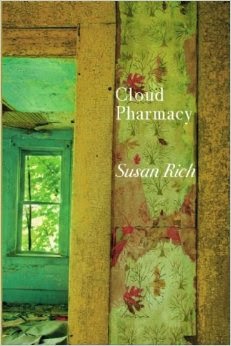
Susan Rich is the author of four collections of poetry, most recently Cloud Pharmacy. Her earlier books are The Alchemist’s Kitchen, named a finalist for the Foreword Prize and the Washington State Book Award, Cures Include Travel, and The Cartographer’s Tongue, winner of the PEN USA Award for Poetry and the Peace Corps Writers Award. Susan has received awards and fellowships from Artist Trust, CityArtists, 4Culture, The Times Literary Supplement of London, Peace Corps Writers and the Fulbright Foundation. Her poems have appeared in the Harvard Review, New England Review, and The Southern Review. She lives in Seattle and teaches at Highline Community College.

Today's poem comes from Susan's new book, Cloud Pharmacy.
http://www.amazon.com/Cloud-Pharmacy-Susan-Rich/dp/193521053X/ref=sr_1_1?s=books&ie=UTF8&qid=1392144143&sr=1-1&keywords=cloud+pharmacy
Click Cover for Amazon
Blue Grapes

There are days made entirely of dust
months of counter-winds

            and years unbalanced on the windowsill.

The soup poured  in the same yellowed cup.

Newspapers appeared like oracles on your doorstep—
glamorous fragments of anonymous love.

            You stayed in bed, read novels, drank too much.

God visited, delivered ice cream; returned your delinquent library books.

Is it simpler after you’re dead 
to watch the living like characters on an old-fashioned TV set?

            The dying are such acrobats—

You see them ringing doorbells with their clipboards
remarking on the globes of lilacs.

            They try to lure you out; request a drink of water,
some blue grapes. This does not work.

            Then the dying leave you to yourself—

to the girl dressed in black, suffused with commas,
and question marks—

            How to write your one blue life?


DL: I’m intrigued by the form of your poem. You alternate 2-line and 1-line stanzas. Then you also alternate lines that are flush to the left margin with lines that are indented several spaces. How did you arrive at this form?

SR: I believe this poem needs the freedom to move across the page; it needs to wander.

My reason for the indentations and alterations is that for me, and perhaps for my readers, the oddness of the subject—God delivering ice cream, for example—is best represented with a physical shape that quietly signals a slightly different type of poem, different let’s say, than straight narrative. Or perhaps my reason for this choice is as simple as this: when I open a journal, my eye is immediately attracted to the poems that frame white space in startling ways.

In my collection, Cloud Pharmacy, I try out different forms for different types of poems. With “Blue Grapes,” which introduces the book, I wanted to explore an interior, surreal, landscape of loss. This unreliable, yet definite pattern emerged. At first, I was afraid that this wasn’t a poem. It arrived in fragments and I was unclear about how the parts would fit together.

I write the first few drafts of a poem in red notebooks with graph paper. My process is often very messy—this form was my way of trying to honor the messiness of thought.

DL: Punctuation seems important in this poem. You violate Richard Hugo’s prohibition against the semi-colon, you pepper the poem with em dashes, in the penultimate stanza you make reference to “commas, / and question marks,” and you include two questions. Tell us your thoughts about the role of punctuation in the poem.

SR: When I was in elementary school in Brookline, Massachusetts, in the late 1960’s, there was little emphasis placed on correct punctuation; instead, the teachers encouraged full expression. Students chose which books we wanted to read for our curriculum and created our own poetry anthologies. Fortunately or unfortunately, this means that since I did not learn the hard and fast rules of punctuation when I was young, I sometimes get into trouble when I am writing. It also means my ideas on punctuation remain fluid.

And yes, I do have a great fondness for the em dash. I’m amazed that it isn’t used more in poetry. Punctuation, like poetry, remains a bit like magic to me. So often poets seem to let go of punctuation in their poems. I prefer to use different punctuation marks for my own strange purposes. I recall Denise Levertov’s strict guidelines for how long to pause after a comma and how long to stop at the end of a line. Many of Levertov's poems were set to music, yet she was never satisfied with the scores; they didn't equate with the music she heard in her head. I offer this by way of explanation. I want to use punctuation to score the poems, to make them equate with the music inside my head.

DL: There’s a surreal element in the poem. You give us “years unbalanced on the windowsill,” newspapers that appeared “like oracles on your doorstep,” and a God who “visited, delivered ice cream; returned your delinquent library books.” How do you achieve these dream-like moments? How hard is it to trust them, to allow them into the poem?

SR: Wow, I love this question, but I want to first turn it around. The dreamlike moments are the core of the poem; they are the force of the vision I’m trying to express. I think of Elizabeth Bishop saying that what she wants while reading a poem is “to see the mind in motion.” My mind goes to the odd and the unlikely. I’ve always been interested in the juxtaposition of the quiet of morning coffee with the news of the world.  As a child the unfolding of the newspaper from itself taught me that the world was out there waiting for me to try to understand it.

Now to answer your question more directly: these “dream-like” moments come easily to me; they are the way my mind works, the way I understand the world. I find no tonal separation between the line “you stayed in bed, read novels, drank too much” and the next line “God visited, delivered ice cream; returned your delinquent library books.” In fact, I do not drink alcohol, so that first line seems more preposterous to me. Poetry works as an avenue of presences, a way to live in the world that exists beyond what we can actually know.

DL: The poem includes a line borrowed from poet Deborah Digges: “The dying are such acrobats.” The line appears just beyond the mid-point, but was it the impetus for the poem? Did it ever appear earlier in the poem? Talk about its influence on the poem.

SR:  Sometimes when I write, I find myself losing interest in a poem long before it’s done—and certainly I do abandon poems. I’m pretty ruthless when it comes to tossing out work. Other times, there’s something that I’m caught on—I’m not ready to call it quits, but I don’t know where the next handhold is hiding.

In “Blue Grapes” I used Deborah Digges’ line to catapult myself back into the work. I was reading and re-reading her book Trapeze at the time. The line arrived in the middle of the process. I think of it as the hinge pin to the poem. I worry a little that my favorite line in my poem is not mine at all. And then I remember that most useful quote by T.S. Elliott, “Immature poets imitate, mature poets steal; bad poets deface what they take, and good poets make it into something better, or at least something different.”

I love the sense that I’m able, through my poems, to have a conversation with the poets I admire, especially those who are now deceased. Shortly before I wrote “Blue Grapes,” a friend introduced me to the work of Deborah Digges and I became immediately transfixed. Her work gave me permission to try many different approaches to a poem all at once. I hear her voice as strongly lyrical interspersed with the vulnerability of grief. In a sense, I needed a bit of bravery to continue on with this poem and her line helped me find it.

DL: Beginning with the title, “Blue Grapes,” colors play a role in the poem. There’s also a “yellowed cup,” “lilacs,” a “girl dressed in black,” and finally, the “one blue life.” The poem has the feel of a still life painting. Tell us how and why you painted in the colors.

SR: I was deep into studying ekphrastic poetry when I wrote this. An emphasis on composition found its way into this piece from the work I was doing on 19th-century women photographers. Another major influence on my poetry is that I teach film studies. I’m constantly asking my students to think in images and symbols, to focus on what is seen.

The irony is that I don’t see this poem as colorful or even very cinematic. And yet I can’t disagree with you. You’ve certainly provided solid evidence to prove me wrong! I think my blindness to the poem's colors has more to do with my own understanding of the poem as coming from a supremely interior world. This particular poem felt hard-won. I’m not writing about an event or an easily identifiable feeling here. Instead, I’m trying to pry open my own sense of consciousness. What does it mean to live as a “self”?

I’m not one to write about my own life and this speaker is not me. However, I am very fond of ice cream.

********************
Readers, please listen to Susan reading her poem, "Blue Grapes," from Cloud Pharmacy.


Friday, May 3, 2013

The Poet on the Poem: Robert Wrigley


I'm delighted to have Robert Wrigley as my guest poet for this occasional feature at Blogalicious.

Robert Wrigley is the author of nine collections of poetry, most recently Anatomy of Melancholy. His awards include the Kingsley Tufts Award, for Reign of Snakes; the Poets' Prize, for Lives of the Animals; and the San Francisco Poetry Center Book Award, for In the Bank of Beautiful Sins. He has been the recipient of fellowships from the National Endowment for the Arts and the Guggenheim Foundation. He lives in Idaho, in the woods, on Moscow Mountain, with his wife, the writer Kim Barnes. He is the Director of the MFA program in creative writing at the University of Idaho.

Today's poem comes from Anatomy of Melancholy.

Click Cover for Amazon

Earthquake Light

                March 11, 2011

Earlier tonight an owl nailed the insomniac white hen.
She'd fluttered up onto a fence post to peer at the moonlight,
to meditate in her usual way on the sadness of the world

and perhaps the hundreds of vanished eggs of her long life here.
I was watching from the porch and thinking she ought not to be
where she was, and then she wasn't, but taken up, a white hankie

diminishing in the east, one the owl would not ever drop.
Now an hour after, the new night wind spins up a leghorn ghost
of her fallen feathers, under the moon and along the meadow grass.

Corpse candle, friar's lantern, Will-O'-the-wisp chicken soul
dragging its way toward me, that I might acknowledge her loss
and her generosity, and wonder again about her long-standing

inability to sleep on certain nights. There are sky lights
beyond our understanding and dogs whose work it is to scent
the cancer no instrument can see. On the nights she could not sleep,


the hen Cassandra Blue perched herself with a clear view to the west
and studied the sky, every two seconds canting her head a few degrees
one way or the other. What she saw or if she saw it I cannot say,

though it seemed that something, always, somewhere, was about to go
terribly wrong. Then again, it always is. Now there's a swirl
of wind in the meadow, spinning three or four final white feathers

west to east across it, and there's a coyote come foolishly out
into the open, hypnotized by feather flicker, or scent, then seeing
by moonlight the too-blue shimmer of my eyes, and running for its life.


DL: Almost every line of this poem contains some kind of musical device. Line 1, for example, has the internal rhyme of tonight and white. The -ight sound is strewn throughout the poem—moonlight, night, might—as are the long i words—Life, friar's, I, sky lights, eyes. There's also a good deal of assonance and alliteration in the poem. Tell us how you create this network of sounds.  

RW: Well, there’s no formula; there’s no scheme or discernible pattern. It’s just what I’ve always referred to as writing—which is, for the most part, the only way I’m interested in writing—via sound linkages. My poems, generally at least, work toward sonic unity. As much as anything else, this is the way I learned to make poems, allowing the sounds of individual words and syllables not only to unify the poem but even to determine its progress. Richard Hugo, who was one of my teachers, always said, when the poem requires a decision between music and meaning, always pick music. This doesn’t mean that meaning—whatever that might be; poems mean, but how they mean is vastly more important than what—should not matter. It means, rather, that “picking music” allows the poem’s language to conceive itself into being. And it forces the poet to employ all of his/her resources in order to make the conceptions of the language cohere. In this regard, the sound of the poem, as Frost would have said, is the sense.

I might also say that I have a particular fondness for the musical power inherent in long vowel sounds. Consonants are mostly percussive, and I love percussion. But vowels are notes. Balancing vowels and consonants is the way we make our music on the page.

DL: Talk about your long lines. Did you write this poem in long lines or revise into them?

RW: I write line by line. Always do. And I have to have some sense of the line, however loose it might seem to someone else, in order to see how the poem might move on. As with the sounds of the words, I let lines—and, therefore, line breaks—help determine the poem’s progress toward a unified structure. As I remember writing this poem, I can’t recall ever trying to make that first line be anything but a longish (15 syllables in all) declarative sentence. And that declaration demands elaboration. The verb nailed, and the adjectives insomniac and white are where the poem’s complexity is begun. Nailed, in this context, is a kind of vernacularism for gotten or, in the case of the hen, killed, although it may also be said that Japan was itself nailed by the March 11, 2011, earthquake. White is pretty ordinary, adjectivally-speaking, but it comes into substantial play in the totality of the poem’s imagery. The natural symbolic values of white are exactly what they are. Insomniac is the ringer, if you will; it was for me in the writing. Chickens don’t have trouble sleeping, usually, but animals have mysterious . . . skills and sensitivities. Thus the cancer-sniffing dogs later on. Once I had the first line, I felt the rhythmical contract was established, so most of the subsequent lines have a similar length, both in terms of syllables and stresses. This is also a unifying strategy. Like Frost, I believe the poem is (perhaps even must be) a momentary stay against confusion.

DL: I've noticed that you have an affection for symmetrical verses, i.e., stanzas with the same number of lines and fairly even line lengths. But I've also noticed a lot of variety from poem to poem in your book, Anatomy of Melancholy. What made you choose 3-line stanzas for this poem?

RW: I like the challenge of regularizing, I suppose. Building stanzas that are not only symmetrical but whose construction comes to be a necessary component of how they get said what must be said: well, that’s just one of the many things that might be described as increasing the degree of difficulty in the work of writing. And I’ve always been of the opinion that increasing the degree of difficulty formally or structurally is part of the process of deepening the poem’s complexity. I like to think these particular stanzas may be read vertically—that is, reading only the last word in each line, in three-word increments—and that a sense of the poem’s deeper statement may emerge.

The difficulty of the art is what addicts us to its creation, after all. We become infatuated with the possibilities of that difficulty, the challenge of the problem of the poem’s writing. I do see, looking back at earlier drafts, that, as I closed in on a final draft, the poem was first in six quatrains. Meaning the opening quatrain ended with a period, with her long life here. This would also have been when I noticed the effect of organizing the poem into tercets instead, so that sadness of the world is both the end of a line and the end of the first stanza. That stanza break allows the opening stanza’s final phrase to ring a bit longer, and what else is the poem about but the sadness of a world in which there is often no running for your life—not from owl, earthquake, or fate.

DL: I see another kind of symmetry in this poem, one of content. Tell us about the parallel between the owl and the hen introduced in the first stanza and the coyote and the speaker in the last stanza, the link between Cassandra Blue and the too-blue shimmer of the speaker's eyes, and the shared sleeplessness.  

RW: The owl is not malign; it’s just an owl. The coyote, like the owl a predator, is drawn by the scent of potential prey, but it sees the eyes of the speaker in the moonlight, and sensing danger runs off. The too-blue shimmer is a play on blueness, depression, which both the speaker and the hen are afflicted by, for some reason.  That the owl’s named Cassandra suggests that her sleeplessness has something to do with a gift (or more likely a curse) for prophecy, even if she knows only that something bad is about to happen. The unspoken presence, of course, is the earthquake, which is also not malignant but merely catastrophic. If there is a greater curse than knowing what will happen, I can’t imagine what it might be.  And yet, the catastrophe that befalls the hen is not something, despite her Cassandra-like gift, she can foresee. Unless it is, which is all I think I can say, without saying too much.

DL: Your poem has several metaphors for the dead hen: white hankie, leghorn ghost, Corpse candle, friar's light, will-o'-the-wisp. Do you have a method for getting your brain to unleash these metaphors? Were there any that had to be omitted?

RW: Only that most of them are synonyms for one another: corpse candle and friar’s light being more of less the same thing as will-o’-the-wispWhite hankie as a kind of remembrance, I guess, and leghorn ghost being, for better or worse, chickenish. But the speaker’s role in the poem to this point is thoroughly passive; he’s a witness to the hen’s pondering and to her being killed. When this onslaught of figures comes in, he’s still sitting on the porch, but he’s active in his imaginative re-seeing, a re-seeing that is an endeavor to understand not only what he has seen and continues to see, but, as it turns out, what he will come to know the larger significance of.  

DL: I consider a title the poem's first invitation to the reader. Yours is simple but elegant and inviting. Nevertheless, I wonder about its connection to the poem. The dating of the poem suggests some connection to the earthquake that occurred on that date in Japan, but the poem is clearly not set in Japan. Is this another kind of metaphor?  

RW: The title came first. This is, almost always, a terrible thing for me. I was probably looking up something else, in a book or on-line, when I came across the phrase earthquake light, and an explanation thereof. It’s a real thing. Mysterious, abundantly theorized upon, and even challenged as myth, it’s something you can look up. There have been many reports of peculiar, seemingly sourceless lights in the sky at or near to areas of seismic, especially extreme seismic, activity. That such a phenomenon is not explainable but has been witnessed is what captured me immediately. The mystery of it appeals to me for many reasons, not the least of which is that I have this sense that there is a similar mystery attendant to the best poems. It’s not just in what gets said but in how it gets said, and that sort of mystery is mythic, bardic, and endlessly sweet to me.

The poem was composed within a few months of the Tohoku earthquake. My wife has had dreams of things happening before they’ve happened. I’ve had one or two. WTF, one thinks. And yet there is something as alive in the earth’s (write it) soul as there is in a poem. A poem written in German by Paul Celan, translated into English by Michael Hamburger, a poem not exactly explicitly stated but still astonishingly, breath-takingly clear: it rings, it resonates, it wallops, in some impossible-to-explain way, what feels like one’s actual soul. That kind of mystery, I mean, in which an insomniac hen may well be aware of or even foresee a catastrophic happening on the other side of the planet. Or perhaps in the vast nervy continuum of chickendom, a Japanese bantam beheld an otherworldly light in the sky, just before the earth itself moved.

Much as I confess I love the word chickendom, I also have to say that I’m honestly and deeply attuned to animals. There’s nothing misanthropic in that. I simply have come to admire the way most animals, especially wild animals, are at ease within their own skins in ways most human beings never are. Of course, Cassandra Blue is both domesticated and anthropomorphized. It may be that her sadness is in that.

***************************
Readers, please enjoy listening to Robert Wrigley read his poem, "Earthquake Light."


Saturday, July 21, 2012

The Poet on the Poem: Ann Fisher-Wirth

I am happy to have Ann Fisher-Wirth here today to discuss one of her poems. This is one I selected last year for the inaugural issue of Adanna for which I was the Guest Editor. I loved the poem then and I love it now.

Ann Fisher-Wirth is the author of four books of poems: Blue Window (Archer Books, 2003), Five Terraces (Wind Publications, 2005), Carta Marina: A Poem in Three Parts (Wings, 2009) and Dream Cabinet (Wings, 2012). The Ecopoetry Anthology, which she is coediting with Laura-Gray Street, will be published by Trinity University Press early in 2013. Her awards include the Rita Dove Poetry Award, a Poetry Award from the Mississippi Institute of Arts and Letters, and two Poetry Fellowships from the Mississippi Arts Commission. She teaches English and Environmental Studies at the University of Mississippi.

Today's poem comes from Dream Cabinet.
 Click Cover for Amazon


It Was Snowing and It Was Going to Snow
Unseasonal weird once in a green moon Mississippi beauty—
deep deep snow. We woke early, dressed,
walked through the silent town and Bailey’s Woods
to Faulkner’s house, before anyone but a deer
had made prints, we trudged through abundance.
I held my husband’s arm down the uneven trail,
the snow-mound stairs of the woods,
because I was afraid to fall, knowing how suddenly
bones break. Again and again when I touch him
I am filled with joy for the sheer fact of him
among all the infinite spaces—this burly,
beetle-browed man with the muscular legs
and fine-pored skin. Now, through my window,
grays and taupes of gingko and maple,
fractals of branches softened and warmed with snow,
then the greens of privets massed shabby beyond them,
and way down the hill, the Methodist Church
just barely red, a smudge through the trees. Someone
has built a snowman, someone is romping with a dog.
Soon night will climb the hill outside the window
where I wait for the white bees to swarm,
surrounding the branches, the house,
surrounding my sleep, scattering their cold pollen again.


DL: Tell us about your title's allusion to Wallace Stevens' "Thirteen Ways of Looking at a Blackbird." Why those lines for your poem? What do you think they add to your poem? At what point did they occur to you as just right for the title?

AFW: In Mississippi, we get heat that will fry your eyeballs and humidity that will curl your toes. The spring and fall are balmy, and it almost always freezes for a while each winter. Nearly every year, there’s a smattering of snow that melts almost as soon as it falls. But we hardly ever have the chance to imitate a Northern climate, such as Wallace Stevens refers to in “Thirteen Ways of Looking at a Blackbird.”  We hardly ever have real snow, deep snow, strange and continuing snow. This is why the title stolen from Stevens seemed right, once it popped into my head. The overnight snow reached shin-high—and best of all, we could tell it would not immediately be over. It was snowing and then it stopped, yet we knew it was still going to snow.

DL: The syntax of your first line is immediately arresting and engaging. How did you arrive at that line? What kind of revision did it undergo? Or was it a gift?

AFW: This poem began as a prose free-write; in the lull after Christmas, when I had a lot of free time before the new semester began, I vowed I would keep a journal every day. Since not much was happening except weather, I wrote about weather. I wanted to write a poem from this day’s prose paragraph and to begin the poem with a rush and tumble of adjectives to convey how surprising, how wonderful this snow was. The line just leapt into my mind. I have to admit, the next day I nearly cut the line. Why? My hyper-rational mind took over and told me there is no such thing as a “green moon” or even a saying “once in a green moon.” Luckily someone told me I was crazy.

DL: Your use of pronouns is intriguing and subtle. You begin, in line 2, with the first person plural "We." In line 6, you split that pronoun in half and speak as "I." This allows a shift from description of landscape to contemplation of love—for the other half of the We. What's said in these middle lines could only be said by the singular I. This movement from exterior to interior also parallels the action of the poem. Finally, this shift brings warmth into a poem about snow. Was any of this on your mind when you made the switch? What was your intention?

AFW: The “we” at the poem’s beginning refers to my husband and me; we took a walk together. “I” takes over when I begin to contemplate my feelings. You are right that the poem shifts at that point to become more inward; I did intend that, as I wanted to poem to expand beyond narrative or description to include this realm of self-awareness about feelings.  I broke my knee about ten months before the day of this snowfall, and had surgery and a long recovery.  That made my progress down this specific snow-covered trail gingerly, but it has also made me intensely aware of the everyday gifts--starting with life itself.    But that is the nature of “I” and “we” anyway: my thoughts are always solitary, even if what I am thinking about is the person walking beside me.

DL: What governed your line breaks? Also, I can see spots where your poem might have been broken into stanzas. Why did you opt for one stanza?

AFW: In this poem most of the line breaks are syntactic yet there is quite a bit of enjambment; only three of twenty-three lines end at the end of a sentence. I wanted a fluid, meditative quality to infuse the narrative, which describes a single arc from daybreak to gathering night. This is why, though the poem is broken into sentences rather than being one long continuing sentence, there are not stanza breaks, and the sentences are handled with variously placed caesurae. One of my favorite poems in the world is Robert Frost’s “After Apple-Picking,” and it just occurs to me that his great poem, too, enacts an arc in a single stanza (admittedly partly through flashback) from sleep to waking to impending sleep.

DL: The "white bees" metaphor that closes the poem is so wonderful. How did you land on that?
AFW: My children had a beautiful book, illustrated by Susan Jeffers, of Hans Christian Andersen’s “The Snow Queen.” The Snow Queen comes to little Kai to carry him off in a blur and flurry of snow like bees. That, of course, is a malevolent image. But it lingered in my mind for its beauty and—if snow is likened to bees—in some weird way, its potential fertility and sweetness. Also, like the blank white screen with the film projector running that always used to come at the end of my father’s slide shows, the snow-bees create an atmosphere of obliteration that is both ominous and comforting. “It Was Snowing and It Was Going to Snow” is the last poem in my book Dream Cabinet. The book begins with “Slow Rain, October,” also a poem about love and family, the natural world, the liminal states between day and night, waking and sleeping. Dream Cabinet as a whole looks back and through the course of a life with its places, events, concerns, and larger historical context, always conscious nevertheless of death and dream.

Readers, please enjoy Ann's recording of her poem.


Related Posts Plugin for WordPress, Blogger...