
Showing posts with label sugar fix. Show all posts

Wednesday, June 29, 2022

Terrapin Books Interview Series: Ann Keniston Interviews Kory Wells


The following is the sixteenth in a series of brief interviews in which one Terrapin poet interviews another Terrapin poet, one whose book was affected by the Pandemic. The purpose of these interviews is to draw some attention to books which missed out on book launches and in-person readings. Ann Keniston talks with Kory Wells about using a central metaphor as an organizing principle, the role of facts and stories in a collection, and the arc of a poetry collection.

Ann Keniston: Sugar is central to your collection, as the book title, Sugar Fix, makes clear. Yet sugar seems to mean different things—at times it’s aligned with desire and pleasure, and at others it’s something to be resisted, an “urge,” in one poem, that the speaker is “unlearning.” Can you talk a bit about how you understand sugar in the collection? How did it become central to the collection? Did its meaning change or become more complex as you worked on the manuscript?

Kory Wells: It’s hard to believe now, but I didn’t know that sugar was going to be such a central motif of the collection for quite some time. I knew I was writing about identity and connection and love, and that I was witnessing to the power of story and memory. I also knew I wanted to incorporate a wider sense of history and social context. But it wasn’t until I wrote “Due to Chronic Inflammation,” which interweaves the speaker’s addiction to sugar with America’s addiction to gun violence, that the bells went off in my head: I can’t tell my story without talking about sugar: red velvet cake, sugar sandwiches, Dairy Queen, marshmallow pies. My ancestors even lived at a place called Sugar Fork! Sugar represents many factual details of my family history. But more than that, for me sugar represents longing: my longing for romance, yes, but more than that, for kinship and connection—even across time and the troubling aspects of our country’s history and present.


Keniston: I noticed that you use the word “fact” several times in the course of the book, often in relation to something you want to amplify or contradict. And then the word “story” also recurs. Can you talk about how you see the relation between those two terms? Are stories a way to correct so-called facts or to amplify or complicate them? Given that many stories are associated with family, especially a grandmother figure, do these stories have the weight of truth, perhaps emotional truth? Or can they also be misleading or deceptive?

Wells: Thanks so much for this question! This tension between stories and facts dominates our entire socio-political climate, right? It’s common to hear someone say, “We need all the facts” and believe those facts tell THE story. But we don’t often hear, “We need all the stories.” And even if we did, how often are we truly open to hearing someone whose story we think we may not like or agree with?

I think that’s what Sugar Fix is attempting to champion, in its own small way—the idea that we need all the stories, and that the best, fullest stories dissolve the line between us and them.

A major thread of this book comes from my obsession with how my family’s oral history jibes—or fails to jibe—with facts I learned from genealogical research and DNA testing. In my experience, the stories my grandmother and other family members told definitely captured some of the truth, and that still matters deeply, even if it’s not the full story.

The facts are that my family traces back to the Catawba, and before that a Saponi tribe, but hearing the story that I was descended from Cherokee who narrowly escaped the Trail of Tears still shapes the empathy and connection I feel today.

The facts are that I’m descended from a woman who was arrested for dancing and masquerading as a man in Philadelphia in 1703. The facts are also that I am of African descent. I can’t say these facts—which are relatively new to me—are life-changing. But they expand my story, and that’s part of what I was writing toward in these poems. How I include new facts in my story, my own self-reckoning, particularly as a person who tries to be intentional about connection and allyship, is, to me, significant.  


Keniston: I was really interested in your use of the word “cousin,” first in relation to the possibly-but-probably-not blood relative Gypsy Rose Lee and then as an addressee in several other poems. It seems like part of the book’s project is to destabilize conventional lineage-based ideas of family, as well as race and history. Can you talk a bit about how you extend the notion of family, maybe especially in relation to your use of form, including renewable forms like the villanelle, sonnet, and ghazal? To put it another way, what is the relation of the theme of family to that of political reimagining in the book?

Wells: Oh, thank you for noticing how I address cousins! Perhaps I’m intrigued by the idea of consanguinity because I’m an only child. Or because I grew up in a small town, where people are more connected than you realize, and you have to be careful you don’t bad-mouth your new friend’s second cousin. Or perhaps, amid our national divisiveness, I’m reaching, reaching for common threads.

At any rate, I think my use of form is, in one sense, a nod to the various rhythms that have shaped me as a Southerner with Appalachian roots: a rich storytelling tradition, the cadence of Southern and Appalachian speech, the rhythms of old time and classic country music, the spread of a Sunday soul food dinner, the particularly Southern customs of hospitality and manners. All of these things ignite my sense of kinship.

I’d be remiss if I didn’t acknowledge that, as someone who came to poetry by way of computer science, I have occasionally felt like an outsider to the literary community. I want to be clear: I do feel a deep belonging much of the time—I have so much gratitude for the kinship of fellow writers! But let’s face it—there are a lot of poets, and it can be easy to feel overlooked. By employing poetic form, I think I am, in a small way, acknowledging literary tradition and saying, “I want to belong.”


Keniston: Can you talk about the shape of the book? Your last section title is “As I Already Said, Sugar” and circles back to some of the themes of the first section. Yet things seem different by the end of the manuscript: several of the poems look forward to an uncertain future rather than back to childhood. Can you talk about how you imagined the arc of the book?

Wells: I enjoy reading poetry collections that have a definite arc, so I started thinking about that with my manuscript early on. Initially, for a few years while I was working on the manuscript, I used a James Dickey quatrain—the last lines of “Into the Stone” —divided into four sections as an organizational device. One of my early readers, a novelist friend, said it was “impenetrable,” so that’s when I backed up and started looking at excerpting my own words as section titles. But the Dickey excerpt was still in my mind: this idea of how the dead “have the chance in my body,” and how that interweaves with stories and what we carry, and the comfort of knowing and being known.

In revision, I also faced the fact that my grandmother, who is a definite character in my earlier chapbook, Heaven Was the Moon (March Street Press) and who I thought I was sort of done with, deserved a greater role in framing the collection. “Untold Story,” which is the first poem in section one, and “When the Watched Pot Boils,” the first poem in the final section, were both written relatively late in the process and reflect how I finally came to understand this collection as being all about story.


Sample poem from Sugar Fix


He drove a four-door Chevy, nothing sexy,
but I'd been thinking of his mouth for weeks


when he finally called me up
and asked if I'd like to get
some ice cream.

I was full from supper and my
thighs sure didn't need it, but
I've never struggled with

priorities. That Dairy Queen
had gone downhill even then—
bright red logo faded like a movie star
who's kissed away all her lipstick—
but it still had a drive-in, and he
knew how I was about nostalgia

and sugar. This is how a place
became our song. We parked
under the sun-bleached canopy
and I leaned over him
pretending to read the menu.
Then at his rolled-down window
we confessed our desires
more or less into thin air,
which now that I think about it
sounds a little like church
and believe you me

I'd been praying about him.
How I wanted him.
How if I couldn't have him,
I wanted to be free
of want. Do you get that way
sometimes? Where all
you can think about is
chocolate, chocolate, chocolate,
or in my case man, man,
that man. The bench seat
of his Chevy became a pew,
the space between us palpable
as the early summer humidity.

I kept telling myself
it's just an ice cream,
but even then I knew
love is a kind of ruin.
When those cones arrived
so thick and voluptuous,
I almost blushed to open my mouth
before him, expose my eager tongue.

                                    
                                       Click Cover for Amazon


Kory Wells is the author of Sugar Fix, from Terrapin Books. Her writing has been featured on The Slowdown podcast and recently appears in The Strategic Poet, The Literary Bohemian, Poetry South, Peauxdunque Review, and elsewhere. A former software developer who now nurtures connection and community through the arts, storytelling, and advocacy, Kory mentors poets across the nation through the from-home program MTSU Write and has served as the poet laureate of Murfreesboro, Tennessee. 


www.korywells.com


Ann Keniston is a poet, essayist, and critic interested in the relation of the creative to the scholarly. She is the author of several poetry collections, including, most recently, Somatic (Terrapin, 2020), as well as several scholarly studies of contemporary American poetry. Her poems and essays have appeared in over thirty journals, including Yale Review, Gettysburg Review, Fourth Genre, and Literary Imagination. A professor of English at the University of Nevada, Reno, where she teaches poetry workshops and literature classes, she lives in Reno, Nevada.
www.annkeniston.com


Friday, June 10, 2022

Terrapin Books Interview Series: Kory Wells Interviews Theresa Burns

Click Cover for Amazon
 

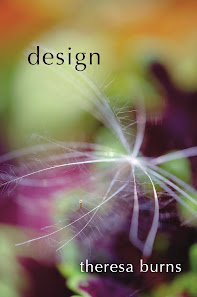
The following is the fifteenth in a series of brief interviews in which one Terrapin poet interviews another Terrapin poet. In this interview, Kory Wells talks with Theresa Burns about her use of color, the role of gardening and humor in her book, running a reading series, and persistence in getting a manuscript published.

Kory Wells: One of the first things to strike me about Design is how color infuses this collection. The epigraphs introduce white and green through the words of Frost and Lorca, and soon the reader is drenched in color: the yellow of a magnolia goldfinch, a hosta "blue as a lung," turquoise storefronts, the gray-greens of dreams, a burgundy dress, and so on. You even have several poems with color in the title—“Green," "Embarrassed by Orange," and "The New Black"—the latter of which I want to talk more about later!

So I really want to know: Is color as important to Theresa Burns the person as a whole as it is to Theresa Burns the poet? For example, what colors are in your home? Do your rooms mostly share a palette, or do they differ wildly? Do you dress in bright colors?

Theresa Burns: I love your question about color! It is important to me, and I think it's become more so as I've gotten older. It's probably rooted both in my kids' enthusiasms when they were young and also what excites me in the landscape.

When my daughter was a toddler and we asked what her favorite color was, she genuinely couldn't decide. "I love all the colors," she'd say, helplessly. (Though I think she's now settled on yellow.) The older I get, the more I'm with her on this. Why do we need to choose? My son, when he was young, loved purple most, then orange. The poem "Embarrassed by Orange" is about him helping me get over my adult need to push color away, blunt it somehow; he gets me to share his unabashed joy in it.

Color has a huge psychological impact on me. If I'm feeling a little depressed or dulled, I run out to find some orange to bring into the house. Orange tulips, a bowl of tangerines. And everyone in my house knows that if they spot an American goldfinch at the feeder, I must be summoned immediately. So colors make their way into the book, too.

Kory: The patterns in your poems are not only emotional—you also deftly layer nature with the made world, with relationships, with identity, with memory. I don’t mean to imply that a lot of the poems in Design are set in a garden…they’re not…and yet I feel this sense of garden and design as creation, if you will, throughout this collection. Are you a gardener?

Theresa: I love gardening, but I'm not a knowledgeable gardener. For a couple of years, I wrote a column for a local online edition of The New York Times. The idea was a person like me—recently moved from the city, who knows nothing about gardening—writing a gardening column. Instead of expert advice, I would write about the trial and error. And I could be funny. Over time, I came to see how much I loved the garden in a way that was not really scientific or knowledge based, but relationship based, story based. Stories about failure and negotiation and learning from your neighbors. When the Times dropped the local edition after two years, I needed another place to channel this new passion I'd developed. That's when the garden started entering the poems.

There are several poems in the book that are titled “Design,” and the first one did begin with the idea of garden design in my head—like the rule of three. But the poem quickly evolved and became as much about faith and intention and luck as any aesthetic concern, themes closer to those in the Robert Frost poem, “Design.” When I realized all those ideas could live in one small poem, I knew it could form the heart of a manuscript.        

While I don’t consider myself a “nature poet” exactly, I am drawn to the language and rhythms and emotional life I find in the garden, and in nature overall. Because you can make mistakes and change your mind, it has helped me to take more risks. It’s also excellent for those of us in recovery from perfectionism, especially writers! There is no room for perfectionism in a garden; we can start things out, but we are not in control. And it is never finished.   

Kory: “Only when I got a little closer to the dirt,” as you say in your poem “Teaching Whitman in the 21st Century.” You are speaking of the passage of time in that poem, but you’re making me want to go dig in my own perennials now!

Another thing that I appreciate in your poems is your tendency toward humor. And that brings me to "The New Black," your poem in which the speaker (can I call her you?) is at a poetry reading, possibly feeling a bit out of place because you're in mom jeans and an orange sweater, "possibly one / with flowers" (I adore that detail!) and everyone else there seems to fit the stereotype of a poet. It’s a super-fun poem and yet it pokes the beast of poetic identity and the sometimes-gatekeeping of the literary community. As the founder of a community reading series (Watershed Literary Events), can you talk more about the intersection of your personal writing practice with the poetry community?

Theresa:
  I'm glad you asked this question because my knee jerk response might have been a glib one about the gatekeeping and cliquishness of some folks in the poetry community. But that, by and large, has not been my experience. That said, the poem "The New Black" is based on a conflation of two real life events, both of which took place in Brooklyn a few years back when my kids were small, and it took enormous reserves of time, money and guilt capital just to get myself into Brooklyn to be part of a reading.

In one case, the poet introducing me seemed to be apologizing to the audience that I lived in New Jersey, stressing that I used to live in Brooklyn, so maybe that mitigated it. In the second case, the poet introducing me to the host seemed to apologize to him for how I was dressed: "She looks conservative, but she's anything but!" I was wearing a blouse with flowers on it, and it was being read as political or social conservatism. And then I became acutely aware that everyone else there was dressed in black and grey, with heavy black boots, and I sort of wrote that poem on the train on the way back to my town that night, where the next day everything was blooming and lots of folks were dressed in bright colors and kind of drunk on Spring, and I felt perfectly at home.   

When I first started Watershed Literary Events in 2019, it was part of a plan in my town to offer some off-site activities while their arts center was being renovated. The town leaders liked the idea of a spoken word series, and I figured well, we could keep this going for a couple years with just Jersey-related people. And what I soon realized was the depth and breadth of the talent out here. It seems every week I learn about another writer I admire who was born here, or moved here, or teaches here. Everyone knows Whitman and W.C. Williams lived in NJ. But Paul Auster grew up in my town, and so did Alicia Mountain, a young poet who I think is brilliant. I'd never heard of Jane Wong or Rachelle Parker before I worked on Watershed—now I'm their #1 fan. I could do this for decades!

Kory:
Yes to all of this! As the founder of a local series myself, I understand—and celebrate—that sense of local richness. But I know I also struggle, sometimes, with getting to my own work when there are so many opportunities for community outreach. So, for a final question: How much do you feed community, and how much does it feed you?

Theresa: I'll just say it's probably worth noting that the poetry book I'd been writing and revising and submitting for about 20 years—Design—finally got done during the last couple of years, while being locked down during a pandemic and continuing to work on Watershed with our Program Manager, Anne Wessel. I don't think that's an accident, and it may be why those wise people who give advice to poets trying to get manuscripts published tell them to keep trying, and while they're trying, to practice their poetry citizenship, help poetry happen around them. It changes something, makes you feel part of the whole continuum of poets and poem making. It helps you find your place in it. 

Sample poem from Design   

The New Black


Because I wore an orange

sweater to the reading, possibly one


with flowers, and had my black

standard-issue MFA glasses


holstered for the moment

in a pocket of my mom jeans,


my poet friend apologized

to the emcee while introducing me,


hand at her throat, assured him

good naturedly that though


I lived in Jersey now, I did in fact

reside in Brooklyn once


and, despite appearances,

belonged among them, the ones


in black leather, black jeans,

Doc Martens, ombre hair, smoke


lenses, each one a small storm

gathering as he took the stage


to read, features illumined

from below, crepuscular,


and I wanted to shout, Am I not

one of you, brother, confrère
—

though I’ve taken the train

to this dive, not the subway.


And the trees of the town I just left

were exploding like seltzer


bottles thrown down a stair.

What’s more, I have a garden there,


and the craziest orange azalea

opened just last week,


its color the latest cheesy
devotion I wear on my sleeve.

Click Cover for Amazon

Theresa Burns' debut collection of poems, Design, was released from Terrapin Books in 2022. She is also the author of the chapbook Two Train Town (2017). Her poetry, reviews, and nonfiction have appeared in The New York Times, Prairie Schooner, New Ohio Review, Verse Daily, The Cortland Review, The Night Heron Barks, Plume, and elsewhere. A Pushcart Prize nominee and former book editor, she is the founder of the community-based reading series Watershed Literary Events and teaches writing in and around New York. An earlier version of Design was a finalist in both the Barry Spacks Poetry Prize from Gunpowder Press and the Homebound Publications Poetry Prize for 2021.
www.theresaburns.org

Kory Wells is the author of Sugar Fix, a poetry collection from Terrapin Books. Her writing has been featured on The Slowdown podcast and recently appears in The Strategic Poet, The Literary Bohemian, Poetry South, Peauxdunque Review and elsewhere. A former software developer who now nurtures connection and community through the arts, storytelling, and advocacy, Kory mentors poets across the nation through the from-home program MTSU Write and has served as the poet laureate of Murfreesboro, Tennessee.
www.korywells.com

Saturday, November 16, 2019

Finding the Right Cover Art for Your Poetry Book


I like to work collaboratively with my Terrapin poets on cover design. Once a manuscript has been accepted, I ask the poet if he or she has any initial ideas in mind. Some know immediately what they want and have already selected a piece of art. If I like it too, we go with it. Other poets have no idea, but most are somewhere in between. That’s when we begin the hunt for the perfect cover. The hunt usually takes some time, but it’s an enjoyable, exciting process. Following is a Q&A with Kory Wells whose poetry collection, Sugar Fix, was recently published by Terrapin Books. I’ve invited Kory to talk with me about our search for her perfect cover.


Diane Lockward: Most poets begin to imagine a cover for their book as soon as the manuscript is accepted. When you learned that Terrapin Books had accepted your manuscript, what cover images came into your head? What expectations did you have for your cover?

Kory Wells: While I was still revising the manuscript, I had the idea that I might like the cover to include or somehow suggest an image of a red velvet cake, after one of the poems in the collection. I'd also caught a bit of inspiration from the photography of Jill Wellington, whose stock images I've used to promote some individual poem publications on social media. 

Despite these ideas, at the very beginning of the process with Terrapin, I was trying to keep my expectations largely in check! I'd had some frustrations working with the publisher of my chapbook to arrive at a cover we both liked. For Sugar Fix, I was thrilled that you wanted my ideas and confident that even though I might not get my first pick, I’d ultimately get a cover I was happy with since Terrapin has consistently produced attractive books. Of course your covers are on your website, but I'd purchased several Terrapin titles before I ever submitted to you. As an author, I think it's imperative to know a press produces a book you'll be proud of.


Diane: How did you go about searching for a good image?

Kory: First of all, I pulled books of all genres from my shelves to consider what really stood out to me. I realized I wasn't against using a photo, but I gravitated more toward some sort of painting or collage.

Next I made a private Pinterest board to share with you some of these images and other cover ideas. I made notes on what I liked about certain covers: the collage on Cecilia Woloch's Carpathia, the fonts and whimsy of Kim Sunée's A Mouthful of Stars, and the intriguing surreal painting on Ashley Seitz Kramer's Museum of Distance, just to name a few. Although my cover doesn't look particularly like any of these, I see now how they informed our path.


Diane: I recall that the first image we seriously considered for the cover of Sugar Fix was a single slice of red velvet cake on a plate floating in air. It initially seemed perfect for your book which several times references red velvet cake. We both loved that image. I enhanced the colors, then muted them. I worked up several sample covers. You did too, but we ended up not using the image. Tell us why we had to abandon it.

Kory: I am quite taken with the work of Charles Keiger, and as you say, his red velvet cake was so tempting to use. On his blog he even says that the painting to him is about nostalgia and longing, two themes that  occur in Sugar Fix. Ultimately, though, the image didn't pass my gut check. Although some of the poems in the book turn toward darkness, the painting felt too moody for the collection as a whole. Some might consider this a poor aesthetic, but I wanted a cover that simply made me feel happy when I looked at it.


Diane: I recall that you next zeroed in on the art of Janet Hill. What attracted you to her work?

Kory: I'd discovered Janet Hill not too long ago when I was adding images to my Pinterest board "The Art of Reading," paintings that show people engaged with books. To me, much of Hill's work is a delightful combination of romantic and quirky; they feel vintage and yet contemporary. Her paintings have a charm that seems very Southern (although Hill lives in Ontario) and are at times darkly comic. I like to think all those same descriptions apply to Sugar Fix.


Diane: You found a kitchen image by Janet Hill that we liked, but I felt it was too similar to the cover of another book that Terrapin had just published. Then there was another one we liked, but when I contacted the artist we learned that it was no longer available. How did we finally arrive at the image we used?

Kory: I confess I still think about that evocative kitchen scene with a teal refrigerator (teal is my favorite color)! But I totally understood Terrapin's need for a different look. I used Canva to make mock-ups of our two final choices, printed and trimmed them to actual book size, and road-tested on my family members. You made some mock-ups with your cover software. Neither of us could argue with the results: the coconut cake on that vibrant green background caught everyone's eye!


Diane: Once we’d settled on the image and obtained the artist’s permission to use it, how did we arrive at the final design?

Kory: The painting itself more or less pointed us to the position of the title and other text; I think deciding the font for the cover was the most important decision. All along I'd leaned toward a script, and you sent several choices. Again, I was printing out options and laying them on the kitchen table to "live with" for a bit. The back cover was all yours—and though the graphic element is a rose, it's delightfully close to a buttercream rose!


Sugar Fix is available at Amazon, B&N, and the Terrapin bookstore.

Related Posts Plugin for WordPress, Blogger...