Showing posts with label karen paul holmes. Show all posts

Thursday, March 31, 2022

Terrapin Books Interview Series: Karen Paul Holmes Interviews Hayden Saunier

The following is the ninth in a series of brief interviews in which one Terrapin poet interviews another Terrapin poet, one whose book was affected by the Pandemic. The purpose of these interviews is to draw some attention to these books which missed out on book launches and in-person readings. Karen Paul Holmes talks with Hayden Saunier about place in poetry, sections in a collection, selecting a publisher, choosing cover art, and reading/performing poetry for an audience.

Karen Paul Holmes: I’ve dog-eared so many pages in this beautiful book, A Cartography of Home. Please tell us how this collection came about. I note a thread of homestead/weather/growing things that almost feels pioneer-like, but in a modern sense. And you do, after all, live on a farm. But there are other-located poems too: mini-market, hotel, church, for example. What can you tell us about the sectioning of the book into four parts? How much of the choosing and ordering of poems throughout the collection was purposeful and how much intuitive? Did you write any of the poems for this book specifically or did you assemble poems already written?

Hayden Saunier: I’ve been thinking about place for a long time. I’m a southerner who moved north into cities for theatre opportunities, but I grew up attached to a rural landscape and with an awareness of the innumerable lives that have inhabited a place long before me. Moving to the farm where my husband grew up reignited that deep connection to a particular landscape, but I also wanted to expand on the ideas of home and place to the those “other-locations” you mention (superstores, mini-markets, churches, press conferences, customer helplines) that have become our current and shared cultural landmarks. And when you walk the same fields and woods every day you are confronted by how time is stacked up in layers in a place, like tree rings and soil, so writing about place and home naturally becomes writing about time. That’s been given as an argument for art: It’s a means to stop time. Or a means to enter a single moment and that feels like stopping time.   

I love sectioning a book because I think a reader needs a place to rest between poems. I know I do. The way a bench is situated on a walking path to allow a moment to consider the view or tie your shoes or just sit. In A Cartography of Home, the first section begins with concrete considerations of home and habitation, and then those ideas ripple outward in the second and third sections, returning to the concrete and actual by the end. The way a walk works when the mind loosens and makes wider associations between the fixed points of beginning and end.

Some of these poems were begun years ago—I am a constant reviser— and some came into being as part of the process. In general, I’m slow to put a manuscript together; it takes me a while to understand around what center of gravity the poems are orbiting. The title poem came together after many revisions and a recognition that people are places too—until they are no longer here—because here is a place. “Navigational Notes” was among the last poems I wrote for this book so it grew out of the endeavor. It grew directly from the Rene Char quote “how do we bring the ship near to its longing,” and how home is a longed-for place. I loved including that imagined landscape as part of the mapping of home. By the end of work on this collection, like all obsessions, everything I wrote was attached to time and place and home.

Karen: Thanks for that great answer! I’m a northerner who moved south, and your ideas of place and time resonate with me. I also sensed in the middle sections of Cartography the “ripple outward” you mention, and that really did work for me as a reader. And “Navigational Notes” definitely got dog-eared on my first read!

This book and How to Wear This Body were both published by Terrapin Books. (And by the way, both have such compelling covers!) You’ve had two other full-length books and a chapbook published with other publishers. Of your 2013 book, the wonderful Laure-Anne Bosselaar wrote, “Hayden Saunier is a poet of wit, irony, and a huge generosity of heart.” I happily find that to be so true of your work today, too. Why did you choose to publish a second book with Terrapin? Tell us about timing, especially considering the pandemic.

Hayden: Yes, Laure-Anne is a treasure. I’ve been fortunate with book prizes and excellent publishers and working on How to Wear This Body with Diane at Terrapin was a continuation of this great good luck. As for the timing of Cartography, it was a gift that my focus on this manuscript during the first months of lockdown coincided with Terrapin’s decision to launch the Redux series. I’ve learned to recognize luck when I see it! I didn’t trouble myself worrying about the timing of publication with the pandemic and the dearth of readings. I just didn’t. Poems find their way in the world all by themselves, I think.

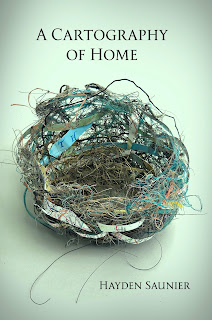
And thank you for the compliments on the cover images. An extra pleasure working on these two books with Terrapin has been that when we couldn’t quite settle on a cover image for either, I created my own. I’m not a visual artist but I know how to look for inspiration, so full disclosure: the multimedia artist Cecilia Paredes inspired the coat image and Rosamund Purcell’s photographs inspired the nest. The experience of creating and photographing the coat and the nest informed both books as much as the books informed the images. That’s been another way the process of working on this book has been layered from beginning to end.

Karen: It’s very cool that you’ve got the skills to create images that exactly work for your books. You’re also an actress and therefore, of course, an excellent poetry reader. In your work, I can tell you take such care with word selection and sound. When I’ve edited one of my poems to a certain point, I often record myself (or read it to my husband) so I can listen to the sounds and line breaks and feel the poem in my mouth. Do you do something similar? How much does your acting background influence the way you write? What are some actor’s tips you can give to poets who are about to do a reading?

Hayden: I am always speaking a poem as I write—it’s natural to me. I love to read aloud and I love the sound and vibration of words in my mouth and head and chest. My favorite moments as an actor have been the times—which are very rare—when all aspects of a play come together with the sound and the meaning of someone’s brilliant words in your body—it’s transportive. Poetry is the essence of that, and it was through theatre that I came to poetry. It’s so much cheaper to produce—no lights, no costumes, no crew! And best of all, you don’t have to wait for someone to give you a job. But I miss the collaboration of theatre and the discoveries one makes when minds and imaginations knock against one another and work together to create a whole world. As for reading tips, I try to let the images and rhythms of the poems tell their stories. And no “poet voice.”

Karen: So true about poetry! And speaking of collaboration, I’d love to know more about the program you founded called No River Twice (www.norivertwice.org/). Your website calls it “an interactive poetry performance group in which the audience interacts with a group of accomplished poets to determine the direction of each performance from beginning to end, poem by poem, co-creating a reading that is never the same twice.” What else can you tell us?

Hayden: No River Twice is so much fun. We’re a group of poets who do readings from our books but what we read is determined by audience interaction—so we never know where we are going to start or end or what we are reading along the way. We follow the images or ideas in poems like stepping stones across a river and make a cento poem from the connecting lines—a collective poem of the reading. It’s surprising and wide-open and encourages us all to listen to poems in whatever way we like and be playful in whatever way we respond to it. It’s never even remotely the same twice. The idea is to connect without judgement to other voices and finding deep human community there. Another reason for poetry.


Sample poem from A Cartography of Home:


A Cartography of Home


My mother was a place. She was the where
from which I rose. Once on my feet, I touched

my forehead to her knee, then thigh, then hip,
waist, shoulder as I grew into my own wild country,

borderless, then bordered, bound

by terrors, terra incognita and salt seas.

I took my compass rose from her, my cardinal points,
embodiments of wind and names of cloud,

but every symbol in the legend now

belongs to me—rivers, topographic lines and shading,

back roads, city streets, highway lanes that end
abruptly at the broken edge of cliffs

where dragons snorting fire

ride curls of figured waves in unknown seas.

Monsters mark the desert blanks on her charts too.
Before she died, I folded myself back

to pocket-size, my children tucked inside

like inset maps and I lay my head down on her lap.

My mother stroked my hair

the way her mother had stroked hers,

and hers before hers, on and on, and we
remained like that—not long—but long enough

to make an atlas of us, perfect bound,
while she was still a place and so was I.

Click Cover for Amazon


Hayden Saunier is the author of five poetry collections, most recently A Cartography of Home (Terrapin Books, 2021). Other collections include How to Wear This Body (Terrapin Books, 2017) Tips for Domestic Travel (Black Lawrence Press, 2009) a St. Lawrence Award Finalist, Say Luck (Big Pencil Press, 2013), winner of the 2013 Gell Poetry Prize, and Field Trip to the Underworld (Seven Kitchens Press, 2012) winner of the Keystone Chapbook Award. Her work has been published in such journals as Beloit Poetry Journal, Nimrod, Southern Poetry Review, Tar River Poetry, and Virginia Quarterly Review, featured on Poetry Daily, The Writer's Almanac, and Verse Daily and has been awarded the Pablo Neruda Prize and the Rattle Poetry Prize. She is the founder and director of No River Twice, an interactive, audience-driven poetry performance group.
www.haydensaunier.com


Karen Paul Holmes has two poetry collections, No Such Thing as Distance (Terrapin Books, 2018) and Untying the Knot (Aldrich, 2014). Her poems have been featured on The Writer's Almanac, The Slowdown, and Verse Daily. Her publications include Diode, Valparaiso Poetry Review, American Journal of Poetry, Pedestal, and Prairie Schooner, among others. She’s the current “Poet Laura” for Tweetspeak Poetry. Holmes founded and hosts the Side Door Poets in Atlanta and a monthly reading with open mic in the Blue Ridge Mountains. She has an MA in musicology from the University of Michigan, was VP-Communications for a global financial company, and has led workshops in business communications, creative writing, and poetry.
www.karenpaulholmes.com

Tuesday, December 7, 2021

The Strategic Poet Update/ news, poems, prompt, and video


My new craft book, The Strategic Poet: Honing the Craft, is now available as both a print book and an ebook. I hope that you will consider the book for your holiday gift giving. And don't forget to give yourself the gift of craft talks, model poems, prompts, commentaries from the poets, and bonus prompts. You should not experience any supply chain issues when ordering this book as it's fully available.

I am very grateful to contributor Karen Paul Holmes who made a wonderful video for the book. She recorded herself reading a model poem by Sean Shearer, "Rewinding an Overdose on a Projector," and then her own Sample Poem, "Slow-Motion, Reverse-Replay, Myocardial Infarction," which she wrote using the prompt that follows Sean's poem. Both poems, Sean's commentary on his use of similes, the prompt, and the video appear below.

From the Exciting News Department: My book has just received the lovely honor of being named a Best Book for Writers by Poets & Writers magazine!

Sample Prompt from The Strategic Poet:

Rewinding an Overdose on a Projector
 
Blacker. Black. The foam drools back
up his chin, over his lips and behind his teeth.
The boy on the floor floats onto the bed.
Gravity returns. His hands twitch.
The heart wakes like a handcar pumping faster and faster
on its greased tracks. Eyes flick open.
Blood threads through a needle, draws into a tube.
The syringe handle lifts his thumb.
The hole in his vein where he left us seals.
The boy injects a liquid into the cotton
that drowns inside a spoon. He unties the leather belt
around his arm, pushes the sleeve to his wrist.
The wet cotton lifts, fluffs into a dry white ball.
The flame beneath the spoon shrinks to a spark,
is sucked inside the chamber where it grows cold,
then colder. The heroin bubbles to powder.
The water pours into a plastic bottle. The powder rains
into a vial where it sleeps like an only child.
All the contents on the bed spill into a bag.
The boy stands, feeds his belt through the loops.
This is where I snip the film and burn it.
What remains are the few hundred frames
reeling: the boy unlocking a bedroom door,
a black jacket rising from the floor, each sleeve
taking an arm like a mother and father.

                        —Sean Shearer

~~~~~
 
Craft Analysis:

The narrative action in this poem is reversed. Something horrible has happened—a heroin overdose. As we all do after horrible events, the speaker wishes to turn back the clock. Therefore, he begins at the end of the story, reversing and undoing each action that led up to the overdose and its catastrophic conclusion.
 
Notice the declarative sentences with their article/subject/action verb construction, e.g., The foam drools, The heart wakes, The boy injects. Notice too the flat, lifeless tone that results from this syntax, ironically at odds with the use of the personal first-person speaker.
 
The imagery makes the scene one we can see. Much of the imagery results from the strong verbs: Eyes flick open, Blood threads, The syringe handle lifts his thumb. The poet forces us to see the scene. And because we see it, we feel it.
 
In lines 5, 18, and 25 the poet employs three powerful similes, each of which illustrates that sometimes a simile works better than a metaphor. In the closing simile, the speaker describes the boy’s black jacket, each sleeve / taking an arm like a mother and a father. This closing simile makes our hearts ache for the boy and his parents.
 
The poet might have given more prominence to the actions by using stanzas, but he opted to use a single stanza which contributes to the poem’s fast pace and the absence of the relief that stanza breaks might bring.

~~~~~
 
Prompt based on Sean's poem:
 
For your own reverse action poem, first choose an event that had a negative outcome. This could be something you experienced, observed, or heard about from someone else. It could also be something you heard or read about in the news. Perhaps a dog getting killed by a car, a heart attack, a house fire.
 
Then make a list of actions leading up to the end. Put these actions in chronological order. This is just a list, not a draft.
 
Now beginning at the end of your list, draft your poem, ending with what’s at the beginning of your list.
 
Use a first-person speaker.
 
Use declarative sentences. Use active and energetic verbs.
 
As you revise, work in some imagery and similes. Put your strongest simile at the end of the poem.
 
How does the single stanza work for your poem? Feel free to try a different format.
 
~~~~~
 
Sean's Commentary: The Function of Similes in his poem
 
Although this poem is sparse in similes, the emotional weight of each one tends to be heavier the more the reader moves through the poem. The first one that appears is the heart being compared to the vehicle of the handcar as it wakes. Not much of an emotional weight, but it begins the poem’s rhetorical structure of the body being this rickety vehicle for the subject. The next two similes are the opposite as they compare inanimate objects to a living thing. These similes are hermetically tied to family, i.e., only child, mother, and father.

“Rewinding an Overdose on a Projector” is about the practicalities of shooting up heroin, an ugly subject matter. When you have the amalgam of a family setting beneath the poem, it creates a much stranger and stronger emotional weight for the reader. That last simile in the poem will always haunt me when I read it. The speaker is clutching these bodies that signify a balance or protection in life—a mother and a father—whereas we already know from the very beginning of the poem that the speaker can no longer be protected.
 
~~~~~
 
Karen's Sample Poem written using the above prompt:

Slow-Motion Reverse-Replay, Myocardial Infarction
 
Shards of crystal rise
from the terracotta floor, swirl
as if charmed by a wizard’s circling wand.
They form the stem, then bowl
of last night’s wineglass, which floats
to the counter
just as his heart starts again,
the slow wingbeat of a great heron,
its reliable lub dub, lub dub.
Purple bruises on his cheek fade,
rosiness returns, feet pulse with cozy blood.
His knees unbuckle. He rises.
Settles into his chair’s knowing shape.

[Pause.     
That’s the stop-action I want
burnt on my retina.]
 
He’s like a buoyant boy on a birthday,
lips pursed for the Bulldog kickoff,
a gruff WOOF WOOF WOOF!  
He’s glued to TV’s pre-game pomp—
Georgia-Alabama—texting buddies 
Tide ain’t gonna roll today!
The ambulance never needs to scream. 
The house isn’t skin-prickling quiet.
My key doesn’t shake in the lock.
On the two-hour trip, my gut isn’t sick, 
my brain doesn’t fast-talk—
his phone must be dead, his phone must be lost.
Instead, I waltz with the hairpin curves,
Cat Stevens singing “Morning Has Broken.”      
My heart stays with October’s trees—
the red flags only their leaves.  

                        —Karen Paul Holmes


Tuesday, January 9, 2018

To Resubmit or Not to Resubmit: That Is the Question


As the publisher of Terrapin Books, I am frequently asked this question or some variation of it: If my manuscript was submitted to your press and rejected, should I resubmit it? Does it make sense to do so?

It occurred to me that it might be useful to have a discussion about this subject, so I invited Karen Paul Holmes, who once asked me this question, to participate in a Q&A. Karen’s new poetry book, No Such Thing as Distance, will be published by Terrapin Books with a release date of February 1, 2018.


Diane:   You submitted a manuscript to Terrapin Books during the first open reading period in January 2016. When it was rejected, were you given any actionable feedback? If so, what was it?

Karen:   Yes, and I really appreciated it. You suggested that the manuscript should not be frontloaded with my childhood and parent poems, but rather, those themes should be braided throughout. Other suggestions were to enhance the music/dancing motif and to include more poems that weren’t in first person.


Diane:  Did you follow those suggestions at the time? Why or why not?


Karen:  I revised and re-ordered the manuscript many many times, and yes, I took the advice before submitting to other presses.


Diane:  You did not resubmit to Terrapin for the following two open reading periods. During that year, were you submitting your manuscript elsewhere? If so, what was the outcome of those submissions? 


Karen:  I submitted to a few more contests and open reading periods. I had no feedback with the rejections except from one editor, who also said that re-ordering the poems was needed. (He had seen an earlier version similar to the one I sent Terrapin the first time). 


Diane:  What made you eventually decide to resubmit to Terrapin?

Karen:  I had seen what a good job Terrapin had done to publicize its books. I admired your own poetry and The Crafty Poet books you edited. I also respected your dedication to publishing good poetry and looking after your poets. I knew you read the submissions yourself, and that was important to me, as well as the fact that you’d actually edit the book rather than just accepting what I submitted.


Diane:  How did you revise the manuscript? Were poems added or removed? Were structural changes made? How satisfied were you with those changes?

Karen:  I added and removed poems many times so that I probably ended up with about 15 versions of the manuscript. It continued to evolve as I wrote new poems and tried different approaches to the whole.

I totally re-thought the structure from many angles. I even tried to make it a chapbook at some point, but just couldn’t pare it down that far. I made a spreadsheet listing each poem’s voice, theme and subtheme, narrative chronology, and form (prose vs couplets vs no stanzas, etc), so that I could consider how the poems related to each other in different ways. I wanted a somewhat logical narrative flow without it being too predictable nor having jarring jumps between poems. I was using recipes as section dividers, so the order within the sections needed to make sense.


Diane:  When you then resubmitted to Terrapin, what happened?

Karen:  It got accepted very quickly!


Diane:  Following acceptance, what process did your manuscript go through?

Karen:  As you will remember, you and I went back and forth on some line edits and other specific changes. I can’t say this wasn’t somewhat stressful for me, because, you know, those lines were sometimes my darlings! But I wanted an editor like you and appreciated your dedication to making it as good a book as possible.

You deleted nine poems that you felt weren’t as strong as the rest, and I was okay with that. You also asked me to add a couple of my poems that you’d read in journals. The order didn’t change much, but you wanted the recipes to be in the back of the book, and I liked that idea. You also gave me written instructions on how to list and format the acknowledgments for poems that had been published elsewhere. While revisions were being made, I asked for blurbs, and three poets were willing to provide them rather quickly.

Once the edits were complete, it was time for the interior layout of the book. You were very quick, and I found very few errors when proofreading the formatted manuscript. I loved the font and style you chose. I also had a trusted friend proof it for me. You and I discussed cover art, and when I suggested a painting by my sister, you enthusiastically agreed. Then we went back and forth on the cover design until a final design was chosen.

As we were wrapping up final details, my beloved dog died. Then, even worse, 10 days later, my life partner had a fatal heart attack. Needless to say, I couldn’t carry on very well. You were kind and moved the publication date to almost two months later, so that I could have a chance to get my bearings. Needless to say, the launch of my book is bittersweet. My beloved was a huge believer in my work, and he was as excited as I was for my second collection. I will be buoyed up by his faith in me as I do readings and other promotional activities.  


Diane:  Given your own experience, what advice would you give to someone considering resubmitting to a press that previously rejected the manuscript?

Karen: I asked you whether Terrapin would be interested in seeing my revised manuscript, and you said yes. So asking the publisher is my advice to anyone who has been given feedback on a previous submission. And, of course, let the publisher know that the suggestions were incorporated into the revised manuscript.

If no feedback was given, I’d urge the poet to be sure to put strong and unusual poems in the front, but also to make sure there are strong poems throughout. Since poets often have a hard time determining which poems are strongest, getting feedback from others helps.

It’s also wise to have someone else read the manuscript, paying attention to whether the order works. The weaving of like-themes throughout the book is very important, because it adds interest and pulls the reader through. I think we poets tend to want to lump like poems together, and that was my first impulse, but I became convinced otherwise.

I have heard that poets should re-submit to presses that have different readers during the next open reading period or contest, because the manuscript might appeal to these new readers. Whether or not there are different readers, the competition will be different each time—a poet’s manuscript might stand out from the pack when it didn’t before, especially if it’s been revised with care. One hears stories over and over of writers who sent their books out for years before being published—perseverance definitely pays.


Karen Paul Holmes is also the author of Untying the Knot (Aldrich Press 2014). She is a past recipient of an Elizabeth George Foundation writing grant and was named a “Best Emerging Poet” by Stay Thirsty Media in 2016. Her work has appeared in such journals as Prairie Schooner, Crab Orchard Review, and Poet Lore. She is the founder and host of the Side Door Poets in Atlanta and the Writers’ Night Out in the Blue Ridge Mountains. Following a corporate career in marketing communications, she now works as a freelance writer. She lives in Georgia.


Karen's book, No Such Thing as Distance, is now available for Ordering


Terrapin Books has two submission periods for full-length poetry manuscripts:

 January 24 thru February 28

August 1 thru August 31

Please read our Guidelines and our FAQs.

Thursday, April 16, 2015

Featured Book: Untying the Knot, by Karen Paul Holmes


Untying the Knot. Karen Paul Holmes. Aldrich Press, 2014.

http://www.amazon.com/Untying-Knot-Karen-Paul-Holmes/dp/0615998984/ref=sr_1_5?s=books&ie=UTF8&qid=1426121327&sr=1-5&keywords=untying+the+knot
Click Cover for Amazon

Karen Paul Holmes is the author of Untying the Knot. She founded and hosts the Side Door Poets in Atlanta and Writers’ Night Out in the Blue Ridge Mountains. She received an Elizabeth George Foundation emerging writer grant in 2012, and her publishing credits include Poetry East, Atlanta Review, and Flycatcher. Formerly the VP of Communications at a global financial services company, she is now a freelance business writer, poet, and “roving” writing teacher whose venues include the John C. Campbell Folk School in North Carolina.

Description:
Untying the Knot tells the story of the sudden loss of a long-term marriage and the eventual healing that takes place. The poems are written with “grace, humor, self-awareness, and without a dollop of self-pity,” according to Poet Thomas Lux.

Blurb:
On its surface, Untying the Knot is about severance—about leaving the beloved behind and, likewise, getting left—but it is also a meditation on the sources of love and language. … Holmes’s voice pushes readers forward into the unknown with confidence, precision, and empathy.  (Dorianne Laux)


Has He Landed Safely?

     I worry that the outstretched legs on the hart are bent the wrong way
     as he throws himself off.
          —from "Stag’s Leap," Sharon Olds

Not at all a graceful takeoff
his leap threw him into the wild blue
ambiguity of an affair.
I now know he had to do it:
had to explore, sail off the edge
of the world.

I now know he had one limb out
of our marriage for years.
Kept trying to balance
his accounts—in his mind            
he and I did not equal happiness
even though I was the wife he wanted
to show. Smart,
pretty enough, a good mother.
He loved me as much as he could
but I did not fill his coffers.

For two years he resisted the lure
of her but it persisted,
a bee in his palm,
until he couldn’t hold it any longer.
He was barely more than fawn
in the ways of betrayal, antlers
uncalcified. Yet he craved
the danger, needed it
like heroin to addle his pain.

He had to leap, to deny the gravity
of his action. To land, gashed
in another galaxy.
Does he speak the language?
Can he breathe?


More Poems by Karen Paul Holmes:

As It Ought to Be

Sound Cloud


Click Here to Purchase Untying the Knot


Related Posts Plugin for WordPress, Blogger...