Showing posts with label the cartography of home. Show all posts

Thursday, March 31, 2022

Terrapin Books Interview Series: Karen Paul Holmes Interviews Hayden Saunier

The following is the ninth in a series of brief interviews in which one Terrapin poet interviews another Terrapin poet, one whose book was affected by the Pandemic. The purpose of these interviews is to draw some attention to these books which missed out on book launches and in-person readings. Karen Paul Holmes talks with Hayden Saunier about place in poetry, sections in a collection, selecting a publisher, choosing cover art, and reading/performing poetry for an audience.

Karen Paul Holmes: I’ve dog-eared so many pages in this beautiful book, A Cartography of Home. Please tell us how this collection came about. I note a thread of homestead/weather/growing things that almost feels pioneer-like, but in a modern sense. And you do, after all, live on a farm. But there are other-located poems too: mini-market, hotel, church, for example. What can you tell us about the sectioning of the book into four parts? How much of the choosing and ordering of poems throughout the collection was purposeful and how much intuitive? Did you write any of the poems for this book specifically or did you assemble poems already written?

Hayden Saunier: I’ve been thinking about place for a long time. I’m a southerner who moved north into cities for theatre opportunities, but I grew up attached to a rural landscape and with an awareness of the innumerable lives that have inhabited a place long before me. Moving to the farm where my husband grew up reignited that deep connection to a particular landscape, but I also wanted to expand on the ideas of home and place to the those “other-locations” you mention (superstores, mini-markets, churches, press conferences, customer helplines) that have become our current and shared cultural landmarks. And when you walk the same fields and woods every day you are confronted by how time is stacked up in layers in a place, like tree rings and soil, so writing about place and home naturally becomes writing about time. That’s been given as an argument for art: It’s a means to stop time. Or a means to enter a single moment and that feels like stopping time.   

I love sectioning a book because I think a reader needs a place to rest between poems. I know I do. The way a bench is situated on a walking path to allow a moment to consider the view or tie your shoes or just sit. In A Cartography of Home, the first section begins with concrete considerations of home and habitation, and then those ideas ripple outward in the second and third sections, returning to the concrete and actual by the end. The way a walk works when the mind loosens and makes wider associations between the fixed points of beginning and end.

Some of these poems were begun years ago—I am a constant reviser— and some came into being as part of the process. In general, I’m slow to put a manuscript together; it takes me a while to understand around what center of gravity the poems are orbiting. The title poem came together after many revisions and a recognition that people are places too—until they are no longer here—because here is a place. “Navigational Notes” was among the last poems I wrote for this book so it grew out of the endeavor. It grew directly from the Rene Char quote “how do we bring the ship near to its longing,” and how home is a longed-for place. I loved including that imagined landscape as part of the mapping of home. By the end of work on this collection, like all obsessions, everything I wrote was attached to time and place and home.

Karen: Thanks for that great answer! I’m a northerner who moved south, and your ideas of place and time resonate with me. I also sensed in the middle sections of Cartography the “ripple outward” you mention, and that really did work for me as a reader. And “Navigational Notes” definitely got dog-eared on my first read!

This book and How to Wear This Body were both published by Terrapin Books. (And by the way, both have such compelling covers!) You’ve had two other full-length books and a chapbook published with other publishers. Of your 2013 book, the wonderful Laure-Anne Bosselaar wrote, “Hayden Saunier is a poet of wit, irony, and a huge generosity of heart.” I happily find that to be so true of your work today, too. Why did you choose to publish a second book with Terrapin? Tell us about timing, especially considering the pandemic.

Hayden: Yes, Laure-Anne is a treasure. I’ve been fortunate with book prizes and excellent publishers and working on How to Wear This Body with Diane at Terrapin was a continuation of this great good luck. As for the timing of Cartography, it was a gift that my focus on this manuscript during the first months of lockdown coincided with Terrapin’s decision to launch the Redux series. I’ve learned to recognize luck when I see it! I didn’t trouble myself worrying about the timing of publication with the pandemic and the dearth of readings. I just didn’t. Poems find their way in the world all by themselves, I think.

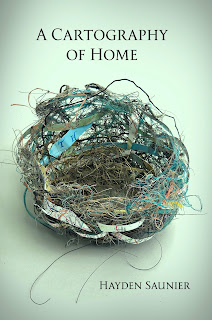
And thank you for the compliments on the cover images. An extra pleasure working on these two books with Terrapin has been that when we couldn’t quite settle on a cover image for either, I created my own. I’m not a visual artist but I know how to look for inspiration, so full disclosure: the multimedia artist Cecilia Paredes inspired the coat image and Rosamund Purcell’s photographs inspired the nest. The experience of creating and photographing the coat and the nest informed both books as much as the books informed the images. That’s been another way the process of working on this book has been layered from beginning to end.

Karen: It’s very cool that you’ve got the skills to create images that exactly work for your books. You’re also an actress and therefore, of course, an excellent poetry reader. In your work, I can tell you take such care with word selection and sound. When I’ve edited one of my poems to a certain point, I often record myself (or read it to my husband) so I can listen to the sounds and line breaks and feel the poem in my mouth. Do you do something similar? How much does your acting background influence the way you write? What are some actor’s tips you can give to poets who are about to do a reading?

Hayden: I am always speaking a poem as I write—it’s natural to me. I love to read aloud and I love the sound and vibration of words in my mouth and head and chest. My favorite moments as an actor have been the times—which are very rare—when all aspects of a play come together with the sound and the meaning of someone’s brilliant words in your body—it’s transportive. Poetry is the essence of that, and it was through theatre that I came to poetry. It’s so much cheaper to produce—no lights, no costumes, no crew! And best of all, you don’t have to wait for someone to give you a job. But I miss the collaboration of theatre and the discoveries one makes when minds and imaginations knock against one another and work together to create a whole world. As for reading tips, I try to let the images and rhythms of the poems tell their stories. And no “poet voice.”

Karen: So true about poetry! And speaking of collaboration, I’d love to know more about the program you founded called No River Twice (www.norivertwice.org/). Your website calls it “an interactive poetry performance group in which the audience interacts with a group of accomplished poets to determine the direction of each performance from beginning to end, poem by poem, co-creating a reading that is never the same twice.” What else can you tell us?

Hayden: No River Twice is so much fun. We’re a group of poets who do readings from our books but what we read is determined by audience interaction—so we never know where we are going to start or end or what we are reading along the way. We follow the images or ideas in poems like stepping stones across a river and make a cento poem from the connecting lines—a collective poem of the reading. It’s surprising and wide-open and encourages us all to listen to poems in whatever way we like and be playful in whatever way we respond to it. It’s never even remotely the same twice. The idea is to connect without judgement to other voices and finding deep human community there. Another reason for poetry.


Sample poem from A Cartography of Home:


A Cartography of Home


My mother was a place. She was the where
from which I rose. Once on my feet, I touched

my forehead to her knee, then thigh, then hip,
waist, shoulder as I grew into my own wild country,

borderless, then bordered, bound

by terrors, terra incognita and salt seas.

I took my compass rose from her, my cardinal points,
embodiments of wind and names of cloud,

but every symbol in the legend now

belongs to me—rivers, topographic lines and shading,

back roads, city streets, highway lanes that end
abruptly at the broken edge of cliffs

where dragons snorting fire

ride curls of figured waves in unknown seas.

Monsters mark the desert blanks on her charts too.
Before she died, I folded myself back

to pocket-size, my children tucked inside

like inset maps and I lay my head down on her lap.

My mother stroked my hair

the way her mother had stroked hers,

and hers before hers, on and on, and we
remained like that—not long—but long enough

to make an atlas of us, perfect bound,
while she was still a place and so was I.

Click Cover for Amazon


Hayden Saunier is the author of five poetry collections, most recently A Cartography of Home (Terrapin Books, 2021). Other collections include How to Wear This Body (Terrapin Books, 2017) Tips for Domestic Travel (Black Lawrence Press, 2009) a St. Lawrence Award Finalist, Say Luck (Big Pencil Press, 2013), winner of the 2013 Gell Poetry Prize, and Field Trip to the Underworld (Seven Kitchens Press, 2012) winner of the Keystone Chapbook Award. Her work has been published in such journals as Beloit Poetry Journal, Nimrod, Southern Poetry Review, Tar River Poetry, and Virginia Quarterly Review, featured on Poetry Daily, The Writer's Almanac, and Verse Daily and has been awarded the Pablo Neruda Prize and the Rattle Poetry Prize. She is the founder and director of No River Twice, an interactive, audience-driven poetry performance group.
www.haydensaunier.com


Karen Paul Holmes has two poetry collections, No Such Thing as Distance (Terrapin Books, 2018) and Untying the Knot (Aldrich, 2014). Her poems have been featured on The Writer's Almanac, The Slowdown, and Verse Daily. Her publications include Diode, Valparaiso Poetry Review, American Journal of Poetry, Pedestal, and Prairie Schooner, among others. She’s the current “Poet Laura” for Tweetspeak Poetry. Holmes founded and hosts the Side Door Poets in Atlanta and a monthly reading with open mic in the Blue Ridge Mountains. She has an MA in musicology from the University of Michigan, was VP-Communications for a global financial company, and has led workshops in business communications, creative writing, and poetry.
www.karenpaulholmes.com

Thursday, March 24, 2022

Terrapin Books Interview Series: Hayden Saunier Interviews Patricia Clark

The following is the eighth in a series of brief interviews in which one Terrapin poet interviews another Terrapin poet, one whose book was affected by the Pandemic. The purpose of these interviews is to draw some attention to these books which missed out on book launches and in-person readings. Hayden Saunier talks with Patrica Clark about manuscript development, the function of a title poem, the selection of cover art, and more.


Hayden Saunier:  I’m fascinated by how poetry manuscripts develop. In Self-Portrait with a Million Dollars was there a central idea or proposition or moment that these poems gathered themselves around? A series of explorations that you return to again and again?

Patricia Clark: These poems that became a manuscript that came to be named Self-Portrait with a Million Dollars are not poems of a project, or an agenda. I can’t work that way—with an aim at a project defined ahead of time. I want to write out of my obsessions and, over time, see what results. What are the threads that unite these poems? Feasts, pleasures, and the falling away, the inevitable loss of such pleasures. The longing for connection with others, with ourselves, and with the world. The elegiac thread of loss, lost moments and chances, and also lost loves and selves, missed connections. The awfulness of flux. We want stability—but stasis is a horror—and we get only fragments, of course. Robert Frost’s description of a poem, each one as “a momentary stay against confusion.” Brief, yes, but such great moments and fragments!

Another way of looking at the poems gathered in the book is to note the epigraph at the book’s front by Elizabeth Bishop: “It is like what we imagine knowledge to be: dark, salt, clear, moving, utterly free.” Each poem included here is a bit (a micro bit) of knowledge, knowledge of living in our world. And I love her adjectives. Be ready for some cold, even frigid, North Atlantic water: “dark, salt, clear, moving, utterly free.” Brilliant. Finally, maybe each poem included here is a self-portrait but not called that, as the title poem is. Moments of living, moments of memory.

Hayden: The title poem appears toward the end of the collection and seems to explore the gap between expectation and reality—but I especially love how it also snapshots your family in a moment before “anyone was sundered,” a richness and wealth that we rarely recognize when we possess it. Could you comment on this?

Patricia: Yes, you put your finger on it: the difference or gap between expectation and reality. I don't mean the poem and the experience's end results to be such a letdown—it wasn't really. The buildup was so good, the vision I had was so spectacular, that of course no reality could ever live up to that. Still, I have the great memory of being there with my father, who took the time to bend to my wishes, and so I have/had it all—just not a glimpse of the coins. Well, until later. I did see them in a pile at the fair in Seattle. Memory has preserved it all, fabulously, and the sweet moment with my father. My goal in choosing a title was to have it be memorable, yes, and also to fit the book. I think it does.

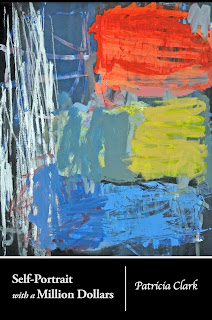
Hayden: Tell me a little about the cover of this book. I’m drawn to its primary colors and abstraction but also to the texture and sense of scribble, the reworking and balancing of the shapes, all of which sounds like a writing process. So perhaps I am projecting my own process here. What drew you to this image?

Patricia: I have met this painter, the painter of "Darn"—Mary McDonnell—she's a Michigan painter from Saginaw, Theodore Roethke country. I love her work. Lots of bold abstractions and lots of marks on the canvas as you describe. She works on canvases on the floor, as I've heard her describe it, and she walks round and round the work trying to figure out the orientation, which edge is up. Yes, to me, the painting seems to reveal a process, quite similar to working one's way through a poem, the confusions, the attention to craft and to letting the "meaning" develop on its own almost. The painting is a record of an exploration—in paint, but very similar to a writer’s exploration in words. I was captivated by the boldness of the images and colors and maybe those primary colors speak, especially, to childhood and youth. Maybe the poems inside the book are, after all, primary experiences of dipping one's hand in cold water, as Bishop describes. And one feels something, an icy jolt. Wow, that's knowledge, huh? I like it. I hope my poems take the reader into such a primary experience—with seeing an owl, or walking in a garden.

Hayden:
  “Feasting, Then” opens the first section with a call to attention to the small marvels and gifts surrounding us in the natural world. “And the Trees Did Nothing” is a poem that confronts our romantic notions about that natural world as the human one literally collides with it—there’s an icy jolt of “knowledge.” These are two examples, but all through the book, your attention and your language focus our eyes and ears on vivid, resonant details of both worlds. How did you develop this keenness of observation?

Patricia:
Thanks for the compliment on "keenness of observation." I'll say right off, it has taken me years. And I'm still not really satisfied. How does one describe what one sees: whether a sky or a tree? Impossible. The real sight still escapes one, I think. What I am up to, I believe, is trying to tell the truth about something I see in the physical world. When I get stuck in the poem, I return to that, over and over. What was there? What else was there? Was that everything? And don't make it too beautiful? what was on the ground? Some trash? some dog poop? Let the "divine details" (Nabokov's words) speak. And they will and the poet can step out of the way. And back to another poet, William Carlos Williams—"No ideas but in things." I have no "idea" what a poem is up to—I want to let the details speak and tell the story, tell the moment. If I can do that well, I've done my job, I believe. And it's not easy, even then. If I get the “small” picture right, the big picture of the poem (its meaning, its thoughts and movement) should take care of itself.

Hayden: Often, a poem doesn’t find a first publisher before being included in a book, a poem that we, as writers, adore and are baffled by the fact that the poem never found a home in a journal.  Do you have a favorite poem from this book that was ignored or homeless that we can give its full due now?

Patricia: I honestly don't remember the poems and their publication history. I could look it up but won't. I’ll pick out a poem that appeared first in Galway Review in Ireland, a place I love. “After the Darkest Year” only made the journey out one time and it was accepted by the magazine right off, and published very quickly. I pick it out for a few more moments of attention because I wish readers would take the time (if they don’t already) to read poems out loud. This poem is one that I think gets on a particular linguistic, sonic roll. And it’s basically all one sentence. I was trying to just describe and describe and not worry at all about where the poem was heading. Just give the horse its head and let it run! So that’s what I did. Is the darkest year just winter, or something more? Oh, let the reader open to whatever thoughts come to him/her. All of those are in there and are correct. Happy reading!

Sample poem from Self-Portrait with a Million Dollars:


After the Darkest Year


Out of verdant and lush,
oak leaf, Virginia creeper vine,
blackberry wild as today’s wind,
sumac, invasive honeysuckle,
each different leaf a knuckle, earlobe, or palm
of the hand,

in thirty days no less, from dormant
to swaying, leaves shivering and trembling,
one side grayer, one side slick,
shiny on top,

and what gets through of sunlight
dappled and shade-crazed,
sunburst down to a single blade
standing tall on ravine-floor,
leaf-pile, leaf mold, crackle
of still dried stalk and spent
blossom trundled from the yard,

an ancient process, green
to done, down, trampled on, spent,
left here to vegetate, pack deep
under snow, decompose,
and then all starts again,

warbler time just after dormancy breaks,
bud swell and pencil point unfurling
of green, each blossom and ear leaf
sparking in its time—trillium, may-
apple, redbud, lilac, more—
and the welcome scents
[cont’d; no stanza]
lively on the air, fresh and new
as any flower, note of honey,
jasmine, vanilla, lemon, bark,

till all is filled, unfurled, spread wide
and out—umbrella canopy, wand of
Solomon’s seal with berries white,
dangling, ripe—and whose mouth
will surround, pull them off to eat?

So sudden you could blink, miss it, lose
sight of dame’s rocket imagining it
phlox when it’s not, lavender, white,
and pink covering a slope, a hill,
an elevated bank by the creek
or by the busy road usually all dun
and trash, dirt, dust, but now
a gorgeous swell, in bloom, so brief.

Click Cover for Amazon

Patricia Clark is the author of six books of poetry, most recently Self-Portrait with a Million Dollars (Terrapin, 2020) and the author of three chapbooks. New work appears in Plume, Tar River Poetry, Paterson Literary Review, Westchester Review, I-70 Review, Atticus Review, Midwest Quarterly and elsewhere. She is professor emerita of Writing at Grand Valley State University.
www.patriciafclark.com

Hayden Saunier’s most recent book, A Cartography of Home, was published in 2021 by Terrapin Books. Her work has been published in numerous journals, featured on Poetry Daily, The Writer's Almanac, and Verse Daily, and awarded the Pablo Neruda Prize and the Rattle Poetry Prize. She is the founder and director of No River Twice, an interactive, audience-driven poetry performance group. www.haydensaunier.com

Related Posts Plugin for WordPress, Blogger...