Friday, July 10, 2015

Bits & Pieces of This & That


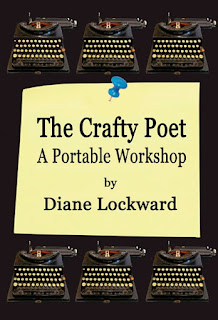
http://www.amazon.com/The-Crafty-Poet-Portable-Workshop/dp/193613862X/ref=pd_sim_14_1?ie=UTF8&refRID=1CZWR2C430JV2AGDY26P
Click Cover for Amazon
Since I've been posting features of poets for the past month, I've fallen behind in the bragging department. Time to catch up. Here's what got me excited and made me happy recently.

First, The Crafty Poet received two more nice reviews. As the book is zeroing in on its second birthday, I am very happy that it continues to attract attention and praise. The first review is by Philip Chase and appears in the 2015 issue of the Journal of New Jersey Poets. As that is a print journal, I scanned the review and posted it on my website. I am very fond of this opening sentence: "With plenty of practical advice, insightful interviews, useful exercise, and original poems from an array of voices and styles, Diane Lockward's aptly titled The Crafty Poet: A Portable Workshop is an invaluable tool for anyone looking to delve into the craft of creating poetry." The entire review can be found HERE.

The second review is by Linda Simone and appears online in Writer's Relief. This reviews begins with this nice sentence: "If you’re looking for the magic bullet to combat writer’s (or poet’s) block, The Crafty Poet, A Portable Workshop by poet Diane Lockward may be the book for you." Read the entire review HERE.


https://www.ebookit.com/books/0000004088/The-Crafty-Poet-A-Portable-Workshop.html
Click Badge for eBookIt
I'm also happy to report that The Crafty Poet E-Book is doing nicely. On the generous recommendation of Scott Wiggerman and David Meischen, co-editors of Wingbeats and Wingbeats II, I used the services of eBookIt for the conversion. I have been extremely pleased with their service and recommend them to anyone looking to convert a print book into an ebook. While I had not expected them to do any editing, they did and my editor did a really great job. Then my rather complicated table of contents required manual inputting which they did for a very reasonable fee. I especially appreciated the open line of communication. Any questions I had were quickly answered. The cost of this service was recovered in less than the first two months of the book's availability. For each of the three months that the ebook has been available, it has been a bestseller. As a result, it has been given a fancy badge on its page. The Crafty Poet ebook is available at eBookIt, Amazon, B&N, and elsewhere.


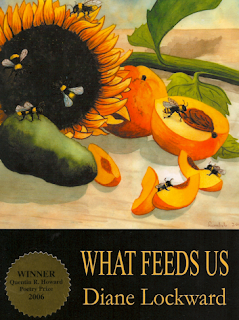
http://www.amazon.com/What-Feeds-Us-Diane-Lockward/dp/1893239578/ref=asap_bc?ie=UTF8
Click Cover for Amazon
Then I had the great happiness and honor of having a poem featured by Garrison Keillor at The Writer's Almanac on Monday, June 22. Linguini was read by Keillor on his broadcast that goes out daily on 600 radio stations. The poem also went out via Keillor's daily newsletter. First published in Poet Lore, the poem later appeared in my second poetry book, What Feeds Us.

In the poem publication department, my poem "Thinking Like a Buddhist" appears in the current issue of Driftless Review.

Then I also have two poems, "We Were Such a Fine Plum Pudding" and "The Gift of a Rat" in the current issue of Compose Journal. This is a beautiful online journal that includes poetry, fiction, and art. The editors also do a great job of promoting the journal and the authors via social media.

My bad news is some nasty poison ivy on my arms which has me dousing my limbs in rubbing alcohol and spreading on copious coats of Wal-dryl. No more weeding for me.


Friday, July 3, 2015

West Caldwell Poetry Festival Featured Poet: Adele Kenny


Adele Kenny is the author of several collections of poetry, most recently A Lightness, A Thirst, or Nothing at All. Her poems have been published in numerous journals and anthologies. She is the recipient of two NJ State Arts Council poetry fellowships, the first place Merit Book and Henderson Awards, a Merton Poetry of the Sacred Award, the 2012 International Book Award for Poetry, and Kean University’s Distinguished Alumni Award. She is the founding director of the Carriage House Poetry Series and the poetry editor of Tiferet Journal. One of her poems appeared on the marquee of the Rialto West Theater in NYC as part of the 42nd Street Art Project. She has twice been a featured reader at the Geraldine R. Dodge Poetry Festival.

A Lightness, A Thirst, or Nothing at All is a collection of 52 prose poems that are deeply rooted in imagery and metaphor. They contain complete sentences and deliberate fragments, speak the language of dreams, and give a nod to the surreal. They often include strange layers of language in which what appears to be abstraction isn’t. Lightness picks up the spiritual journey begun in the earlier What Matters and moves that journey forward.

Praise for A Lightness, A Thirst, or Nothing at All:
"Hardwired by Kenny’s gift for dimension and her profound understanding of the human spirit, the poems in this collection show us the healing power of attention and awareness. Kenny’s words move associatively (and swiftly) through image and sound, and she makes a particular music that is uniquely her own. Impelled by lyrical precision, these poems cast light on what we are learning, and what we already know, about ourselves. This collection contemplates the ways in which the “interior life and the outside world intersect” and is a must-read for anyone interested in looking beneath the surface of things. In addition, through the process of these poems, Kenny leads us to see that, as C. S. Lewis wrote of the spiritual journey, '… there must be a real giving up of the self.'”—Alex Pinto, Tiferet, Spring 2015
Click Cover for Amazon

Adele sent us home with these suggestions for revision. Hopefully, you can put them to use on the poems you've written to the prompts offered by the other festival poets.

Often when I conduct poetry workshops, I give participants the following list, which is not a standard “prompt” but something I hope will be useful when you work on editing.

1. Try to write in the active, not the passive, voice. To do that, it can be helpful to remove “ing” endings and to write in the present tense (this will also create a greater sense of immediacy).

2. Be on the lookout for prepositional phrases that you might remove (articles & conjunctions too).

3. The great author Mark Twain once wrote, “When you catch an adjective, kill it. No, I don’t mean utterly, but kill most of them—then the rest will be valuable. They weaken when close together. They give strength when they are wide apart.” This is especially true in poetry. So ... as you work on a poem, think about adjectives and which ones your poem can live without. (Often the concept is already in the noun, and you don’t need a lot of adjectives to convey your meaning.)

4. Avoid clichés (and, while you’re at it, stay away from abstractions and sentimentality).

5. Show, don’t tell—through striking imagery, a strong emotional center, and an integrated whole of language, form and meaning.

6. Challenge the ordinary, connect, reveal, surprise! And … remember that a poem should mean more than the words it contains.

7. Create a new resonance for your readers, a lit spark that doesn’t go out when the poem is “over.”

8. If you take a risk, make it a big one; if your poem is edgy, take it all the way to the farthest edge.

9. Understand that overstatement and the obvious are deadly when it comes to writing poetry. Don’t ramble on, and don’t try to explain everything. Think about this: a poem with only five great lines should be five lines long.

10. Bring your poem to closure with a dazzling dismount. (Be careful not to undercut your poem’s “authority” by ending with trivia or a “so what” line that doesn’t make your readers gasp.)

Something to Try:

1. Take a look at a poem you’ve already written and apply the preceding items as a checklist for editing.

2. Go through your poem one item at a time and see if there are changes you can make.


3. After you’ve finished, compare your original version and the newly edited one. Is the edited version stronger than the original? 


Friday, June 26, 2015

West Caldwell Poetry Festival Featured Poet: Therese Halscheid


Therese Halscheid was one of the six featured poets at the 2015 West Caldwell Poetry Festival.

Therése Halscheid’s most recent book of poems is Frozen Latitudes (Press 53). Other collections include Uncommon Geography, Without Home, Powertalk, and a Greatest Hits chapbook. Her poetry and lyric essays have appeared in many journals, among them The Gettysburg Review, Tampa Review, Crab Orchard Review, and Natural Bridge. By way of house-sitting, she has been an itinerant writer for several years. Her travels have taken her from the Florida Panhandle to the Arctic north of Alaska, where she lived with and taught poetry to an Eskimo Inupiaq tribe.

Frozen Latitudes melds two journeys, where lives are at the very edge of survival. One is the literal location of Alaska where Halscheid lived among clans of an Inupiaq tribe, as well as in the frontier town of Homer. The second location is the place and time where her father’s life was frozen when, during heart surgery, he suffered brain damage. In this collection, the journey into the cold becomes a metaphor for a family struggling with dementia.


Praise for Frozen Latitudes:
“'My lips, bright as scars, are parting / open with words,' writes Therése Halscheid. In these moving poems of loss, interwoven with vivid poems inspired by people and the landscape of Alaska, she composes resonant lines imbued with deep emotion."
          —Arthur Sze, author of Compass Rose

Frozen Latitudes won Honorable Mention for The Eric Hoffer Book Award for Poetry. The collection is reviewed in the US Review of Books. Read the Review

Click Cover for Amazon

Trash Day

This is how it really looked long ago….

This is myself back in time, a girl
with sallow skin, dragging metal cans to the curb,
notice how I stand for awhile that far from our house
watch how my lips, bright as scars, are parting
open with words so the great air can take them
out of their mystery --

see how my thoughts form the storms, how the morning sky
fills with dark sentences

always something about aphasia, his dementia,
something always about my father caught
so quiet inside me

that would rise in the wind to become
something readable.

I am only fourteen. But you can tell I look old
as if life is ending. Notice how my limbs droop so
willow-like over the trash, see how the cans
are all packed with food, know I am starving myself, I am
that full of my father….

These are our neighbors, each turning in their sleep as they wake,
each waking as they turn from their room to the window
watching the weather above them.

And this is an image of the whole town in shock.
See how they dread my gray hovering grief, just watch
as they walk, how they carry on with the endless clouds
I made weekly, correctly, so very awful and coming
into their eyes.


Here's the prompt that Therese challenged us all to try:
  
Select a topic that is risky for you and allow yourself to free-write about it. A few lines, a paragraph, a page, it does not matter. Just spend a few moments writing. Then go back to what you have written and circle a sentence or phrase. Lift it out. Using that sentence or phrase as a starting point, free-write again. This exercise is helpful in allowing you to experience how writing unfolds in layers. Note how you are moving from a surface experience to crisp details, from abstracts to images. You can try this again and again as a way to enter the heart of the matter, which then becomes powerful material for a poem. 

Friday, June 19, 2015

West Caldwell Poetry Festival Featured Poet: Charlie Bondhus


Charlie Bondhus’s second book, All the Heat We Could Carry, won the 2013 Main Street Rag Poetry Book Award and the Publishing Triangle’s 2014 Thom Gunn Award for Gay Poetry. Previous publications include How the Boy Might See It (Pecan Grove Press, 2009), and two chapbooks, What We Have Learned to Love—winner of the Brickhouse Books 2008-2009 Stonewall Award—and Monsters and Victims (Gothic Press, 2010). His poetry appears in numerous periodicals, including Poetry, Tupelo Quarterly, Midwest QuarterlyCounterPunch, and Cold Mountain Review. He teaches at Raritan Valley Community College in New Jersey and is the Poetry Editor at The Good Men Project.

All the Heat We Could Carry is a collection of poems written primarily in the voices of a gay soldier returning from Afghanistan and his civilian lover. The poems alternate between the battlefront and the home front, exploring, as they do, questions of masculinity, commitment, and violence.

Praise for All the Heat We Could Carry:
"All The Heat We Could Carry is a rare, brilliant and necessary book, offering a people who have lived well during the war a species of lyric night-vision, a camouflage night, wherein we are taught to field strip a rifle, but also to think about 'the soul, / a puff of wind / shot from the mouth.'" Our wars come home in these poems, through a prophet who’s seen hell, who now lives in the aftermath where all is refracted through the searing lens of wounded memory: 'the sun now heavy as a blood bag, where it is hard to tell / the difference between civilians and ghosts.' These poems move with precision from war to home and back, from stun grenade, body bag and bone saw to a garden in winter. If you want to know, or think you want to know, you must read Charlie Bondhus. If you want to know why, pay attention to the fifth section of his poem 'A Talent for Destruction.' Bondhus is a true poet, and this is among the best books I have read in a very long time."—Carolyn Forché

Click Cover for Amazon
Homecoming

Earlier you had written me
about the roadside bomb’s
oranges, blues, and pinks,
which threw 200-lb men,
wearing 80 lbs of equipment,
into the hot, metal wall
of an Abrams tank.
When you came home in May,
I had a planter
of spiky bougainvillea on the porch;
the first thing you’d see,
a different kind of explosion.

We went to the bedroom
to tend to your body, starved
from fifteen months of hard living.
I smelled chemicals, felt shrapnel’s grit,
saw the places you had been burned.
You told me about the sliver
of metal lodged in your right calf,
bone deep, inextractable, that would not
affect your ability to walk or sit
but would always be there, much in the same
way there will always be war
someplace, affecting our lives.

Lying naked beneath the whup, whup
of the ceiling fan as you smoke
on the porch, I think about flowers and bombs,
the books I read on combat fatigue,
and wonder if this thorn in your leg
is attached to a stem that runs
the length of your spine,
exploding, in your head,
a white phosphorous bloom.


Please give Charlie's prompt a try: 

In the spirit of Sei Shōnagon's Pillow Book, make lists of quirky things. Things I wish I had never said. Red things. Things more embarrassing than nudity. Things to put off as long as possible. Things to die for. Acid things. Things that last only a day. Things that should not be seen by firelight. The lists might inspire poems...or perhaps they are poems themselves.


Charlie has generously offered to have this Call for Submissions posted here. Check it out.

From Charlie Bondhus​ for The Good Men Project: People of all genders are warmly invited to submit poetry (simultaneous submissions AND reprints fine!) to The Good Men Project, a website dedicated to discussing what it means to be a good man in the twenty-first century.

On average, the site gets 3.3 million unique visitors and 8 million page views per month, and each published poem gets featured on the site for several days, so this is a very visible venue! Oh, and the poetry section is listed as one of the "Most Personable Poetry Markets" on Duotrope!

Work dealing with men or masculinity is a plus, though our first standard is simply high quality poetry.

Submit up to 10 pages of poetry, as an attachment, to charlie@goodmenproject.com. 


Friday, June 12, 2015

West Caldwell Poetry Festival Featured Poet: Anna M. Evans


Anna M. Evans is the author of Sisters and Courtesans (White Violet Press (2014) and a chapbook, The Stolen From: Poems about Memory & Alzheimer’s. Her poems have appeared in the Harvard Review, Atlanta Review, Rattle, American Arts Quarterly, and 32 Poems. She earned her MFA from Bennington College, and is the editor of the Raintown Review. Her awards include fellowships from the MacDowell Artists' Colony and the Virginia Center for the Creative Arts, as well as the 2012 Rattle Poetry Prize Readers' Choice Award. She teaches at the West Windsor Art Center and Richard Stockton College of NJ.

Anna's description of her collection:
Before writing Sisters and Courtesans, it occurred to me that, until Anne Bradstreet, the only women writing poetry were outside of society in some way—some royals, but mainly cloistered women and women of easy virtue. Everyone else was busy having babies and raising chickens. I felt it would be interesting to explore women’s lives throughout history using that lens and the sonnet as a form, and to attempt to see what else such women might have in common.

Praise for Sisters and Courtesans
"If sonnet means 'little song,' what Anna Evans has crafted here is a sassy selection of female singers, a spirited chorus that takes the figures of different women throughout history, giving life to their stories with frank audacity and lively craft. This book is full of surprise after delightful surprise, deft rhymes and scandalous turns. This is a book to pass from sister to sister, from woman to woman, from friend to friend. But don't worry, fellows, you too will be equally charmed and delighted by this poet who has all the necessary lines and lives to make the sonnet sing with voices you never will think of again in quite the same way."—Allison Joseph

Click Cover for Amazon

My Life as a Camp Follower

The fight keeps dragging on. My soldier lover
was badly wounded by a Yorkist axe.
I came here in the hope that he'd recover,
and stayed on after, in the army's tracks.
It's easy living—all the men are lonely
and most are gentle. I say I'm a nurse
although I tend to them in one way only
and then I slip their pennies in my purse.
I use a pessary of wool and wine
and drink mint tea in secret. If they saw
they'd call it witchcraft. Well, the risk is mine,
all part of women's lot. The men make war
and corpses pile crotch deep in England's mud.
So many things in life come down to blood.


Anna sent us home with this challenge: Write a sonnet from the perspective of someone who lived in a different age from our own, but do NOT make them a famous or named person in history. Include a non-alcoholic beverage and an eye rhyme.

Friday, June 5, 2015

West Caldwell Poetry Feature: R.G. Evans


R.G. Evans, aka Bob, was one of six featured readers at the 2015 West Caldwell Poetry Festival.
 
R.G. Evans' first collection, Overtipping the Ferryman, received the 2013 Aldrich Press Poetry Prize. His poems, fiction, and reviews have appeared in Rattle, The Literary Review, Paterson Literary Review, Lips, and Weird Tales, among other publications. His original music was featured in the 2012 documentary film All That Lies Between Us. He teaches high school and college English and Creative Writing in southern New Jersey.

Overtipping the Ferryman is a collection of poems ranging from the dark to the darkly comic. Themes include mortality, the art of poetry, grief and loss, and the natural world. Most of the poems are free verse, but the book includes formal poems such as sonnets and a villanelle as well.

Praise for Overtipping the Ferryman: 
“With an ear that searches and regularly finds language that complicates and fulfills his apparently Manichean vision, R.G.Evans navigates between reverence and irreverence in these often terrific poems. Death and fire dominate their imagery, and a kind of spiritual ferocity their tone. These are spiritual poems that don't attempt to console. They are poems of complicity. Their speaker wants “more,” and knows something about its price. To overtip the ferryman suggests the anxiety behind the journey, the uncertainty of the arrival. It doesn't get much better than this.”

—Stephen Dunn


http://www.amazon.com/Overtipping-Ferryman-R-G-Evans/dp/0615938019/ref=sr_1_1?ie=UTF8&qid=1388626085&sr=8-1&keywords=overtipping+the+ferryman
Click Cover for Amazon

Month Without a Moon

Any night I like, I can rise instead of the moon
that has forgotten us, not a thought of our sad lot,
and roam the darkened oblongs of the dunes.

Once you said the moon was some pale god
who turned away his face to cause the tides,
and once you said that, I of course believed

that you were mad. Now the ghost crab guides
me to the edge where land is not land, sea not sea,
and all the sky above is one dark dream.

This is the month with no full moon. You
were its prophet, and I am standing on the seam
between belief and what I know is true.

I gave you a diamond. It should have been a pearl.
It should have been a stone to hang above the world.


Here's the prompt Bob sent us home with. Give it a try:

In one of the most famous scenes from the film Jaws, Quint, Brody and Hooper sit in the cabin of the Orca drinking and comparing various scars they have (moray eel bite, thresher shark’s tail). Quint reveals that one mark on his arm is a tattoo he had removed: the USS Indianapolis. He proceeds to tell the true story of the Indianapolis, the ship that delivered the Hiroshima bomb and which ultimately sank, many of the survivors attacked by sharks before the rest could be rescued.

Like Quint’s, the marks on our bodies tell the stories of our lives.

Make a list of all your bodily markings: scars, tattoos, piercings, etc. If you want to go deeper, you can list your emotional scars as well.

Write a poem either 1) in the voice of one of your scars speaking to you (recalling how it came to be, what it has to teach you, etc.) or 2) in the form of a dialogue between two of your scars/markings speaking about you in the third person.

Thursday, June 4, 2015

West Caldwell Poetry Festival Features


On Sunday, May 17, I ran the West Caldwell Poetry Festival, something I've been doing for the past twelve years. For the first ten years the focus was on New Jersey's literary journals. Each year I invited twelve journals to participate. Each editor then invited two representative poets to come and read. Journals were on display and for sale in the reference area while readings took place in the Community Room.

Then last year I began to feel that a change was needed so switched the focus to poets with new books. I invited six poets to be featured at the festival. The journals were again included, but the editors did not invite poets to read. Instead, the six featured poets read in two groups of three, each for 15-17 minutes. Journals were for sale as were the poets' books. There was also a panel during which the poets discussed process. And there was a publishers' panel.

This year I decided to repeat last year's format but omitted the publishers' panel so that the readings could be a bit longer as could the browsing time.

Our featured poets this year were Charlie Bondhus, Anna Evans, R.G. Evans, Doug Goetsch, Therese Halscheid, and Adele Kenny. They were all terrific!

In order to extend the festival's reach, I have invited each of the poets to have a feature here on my blog. Those features will begin tomorrow, Friday, June 5. Please be sure to check in and get a sample of the wonderful poets and poetry we had at this year's festival.

Visitors browsing the journals and meeting the editors
Poets signing books after the panel discussion

Related Posts Plugin for WordPress, Blogger...