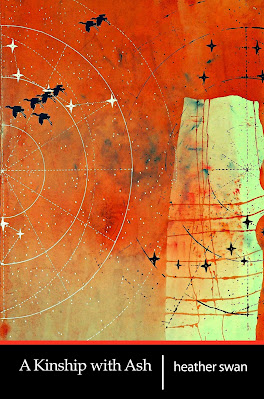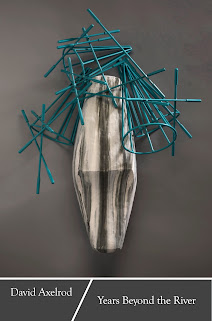
Heather Swan: David, your book, Years Beyond the River, is filled with such a wide array of specific language describing the plants and animals in the landscapes you inhabit. Did you cultivate this intimate knowing and capacity for naming these things as an adult or did you grow up knowing them? And what is the importance of that naming to you?
David Axelrod: That’s a great question to begin with and the answer is yes and no, or more precisely it wasn’t and isn’t an either/or matter for me. My maternal grandfather was enchanted by living things and plant lore, and I was prone to grotesque cases of “poison ivory” as he used to say (he also enjoyed punning). It was he who taught me about the cooling effects of the crushed stalks of jewelweed, that is, spotted touch-me-not, which grew in abundance in the creek bottoms and along farm lanes. I recall him washing my legs with the crushed plant after I’d inadvertently walked through poison ivy in shorts, and for once I didn’t suffer the consequences of my blindness to things. I’d found an ally! He taught me to identify animal tracks, common birds, trees by leaf and bark, the stars, and stories of rare things I must never miss an opportunity to see should they ever return, such as the Ohio Buckeye or Halley’s Comet, which he saw as a child. We even planted a small forest together of birches and pine. I realized that only by knowing a name would I even be able to begin to perceive what is named. The animating anxiety there is being otherwise blind to what we can’t name. I’m reminded too of something Zbigniew Herbert wrote in his poem “Never About You”: “Don’t be surprised that we can’t describe the world / we just speak to things tenderly by name.” That tenderness is what I hope to convey when I name things in poems. It’s the tenderness my odd grandfather felt for life and wished to share with me.
Heather: There is a dominant awareness of deep time, of river valleys changing shape due to dams, of glaciers disappearing, of missing forests, and human life seems to be dwarfed by these long-term landscape changes. However, there is also an indictment of the human, our capacity for folly and destruction—forest fires, mining, internment camps. In "As the Mountain Dreams It," you write, "There it is. The world/ as the mountain dreams it, / going on after as it went on before us––" but in the end ask, "Does whatever the mountain dreams end / without us / if it wakes in a world we set afire?" What are you hoping the reader will glean from these observations and questions?
David: The deep time you refer to is something I feel we are immersed in, despite the many distractions that plague us. Perhaps what we’re referring to here is scalar time, that is, magnitude minus a directional vector. As for the poem, “As the Mountain Dreams It,” the first reference you quote is a gesture toward an awareness of deep time we’ve been speaking of, but also the brevity of human existence, both in personal terms and as a species. This is simply factual. There’s another question asked there at the end that precedes the final question. “If people live inside some spectral order, / does it matter how / or how long we abide here?” That’s the ontological gauntlet being thrown down by the poem. Are human beings really the subject of life on earth? We have an ecologically ruinous global economy based on that very claim. Is the meaning or value we attribute to objects entirely dependent upon our subjectivity? An alarming carelessness attaches itself to such delusions. That carelessness borders on nihilism. The final question the poem asks, depending on the reader, might cause a moment of self-doubt about what kind of reality we actually dwell in.
Heather: The poems have a keen awareness of language and memory. In "Memory Hoard" the narrator witnesses "ice retreating in blue leads/ before our eyes, a magnitude of memory/ we have no story for." And in "Hiraeth," which I learned was a Welsh word for a "longing for home" (and sometimes even a home that was erased or never existed), the narrator wants the language to describe things like "a word for fog gathering overnight/ in inland valleys?" and asks, "What word did father use whenever he pointed to that portion of a field set aside/ for reasons no one knows?" Are your poems a way of preserving memory or creating it? Do you think humans are forgetful and what implications does that have?
David: Yes, of course, human beings are forgetful, and the implications are as dire today as 10,000 years ago or in whatever future there may be for life on this planet. Both poems share some DNA, which in a way, I suppose, is life’s memory of itself. And both poems found their inspiration during a backpacking trip in the North Cascades, though they are in no way delimited by that experience. I mean, “Hiraeth” is entirely invented and responds to the latter definition you cite in your question. Each poem—through lived or imagined experience—wants to get at something strange about how language and memory construct meaning at the porous borders between self and other. How can we learn from what we have forgotten seems to be the question that “Hiraeth” asks. “Memory Hoard” perhaps asks us to consider how to deepen memory.
Heather: The book is filled with elegy for people and landscapes, and yet it also sings of so much beauty and renewal, of moments when "seeds parachuted past us all the way down Slick Rock Canyon." Do the poems or the writing of them give you hope and/or the possibility of healing?
David: We have to be realistic about what we face. There is, after all, much trouble ahead. It offends our sensibility too when our virtuous individual actions to mitigate damage are meaningless given the scale, say, of climate change. The persistent failure of our collective actions, too, renders us hopeless. Obama’s election didn’t after all signal the advent of a post-racial era in the US or anywhere else; it simply brought to the surface our tormented and corrupt origins as a nation, while providing hostile actors the opportunity to manipulate us into turning against each other. And here we are. And yet, I feel the power still in Auden’s reflection at the disastrous beginning of this era of ever-escalating harm to life. “May I, composed like them / Of Eros and of dust, /Beleaguered by the same / Negation and despair, / Show an affirming flame.”
Heather: Your work has been compared to that of Roethke's and Hugo's. In some ways it seems to be speaking to Mary Oliver (especially aspects of "Summer Evenings in the Grande Ronde Valley"), Elizabeth Bishop, and Gary Snyder. Can you say a bit about your evolution as a poet and perhaps who influenced you as a writer?
David: One summer in the mid-70s a high school teacher enrolled me in a poetry writing program in Michigan, and I hitchhiked there the summer I turned eighteen. There I met mostly students destined for elite schools and literary adjacent careers. But my teachers that summer were three very generous and kind poets, Conrad Hilberry, Colette Inez, and Henry Taylor who one day pointed at a copy of Shall We Gather at the River in the bookstore and told me to buy it. I did as he said. That was the moment my so-called life as a poet began. James Wright’s poems, their language, their characters, and attitudes were all familiar from my childhood in Ohio and burst inside of me like thunder. I trembled as I read them beside a campfire one night while hitchhiking home.
The formal reserve and grace of Bishop’s lines made a strong appeal to me. Jeffers, Everson, and Rexroth were all far more important to me, however, than Snyder. Discovering Cid Corman’s journal, Origin, also had a big impact. It was there I first encountered Lorine Niedecker’s work, whose skill at creating nuance with silence introduced a new kind of music to my ear. My work is as influenced by novelists, filmmakers, music, visual arts, philosophy, and science as by other contemporary America poets. Truly, Georg Trakl, Paul Celan, Milosz, Szymborska, Zbigniew Herbert, Tranströmer, to say nothing of T’ang Dynasty poets, have all played and continue to play outsized roles in my imaginative life.
Sample poem from Years Beyond the River:
HIRAETH
i
I can't tell you what word meant
to kneel in forests.
Or why people are empty-handed,
who once hauled buckets.
Where did we draw water and for whom?
I used to follow my sister
to a lake I can't find on any plat
and I forget the irregular verb
to walk uphill carrying fresh water.
Sometimes we spilled a little under
a canopy of limbs. But I don’t recall,
were there two inflections
for water spilled under barren limbs
and spilled inside a sphere of green mist?
Lives unfold the same now as then
except for our having become
transparent. Who knows
the word for fog gathering overnight
in inland valleys? Does anyone remember
ii
the name of the clan who lived
alongside a river that sank underground?
Their festival boomed according to
an interval we couldn't forecast,
so, it was always a wonder—
dancers in heavy costumes at the riverside,
drums filled with thunder,
a ritual reenactment of their route
from another river gone dry for them
elsewhere long ago.
iii
What did we call cool and wet
if it arrived at just the right time?
What did a future do?
What time of year did we share food
in twilight, at ease with strangers
in a ring of piled stones?
The name of which remains blank.
Were those galant syllables joy
our mother sang of
when there was enough to spare?
What word did father use
whenever he pointed
to that portion of a field set aside
for reasons no one knows?
 |
| Click for Amazon |
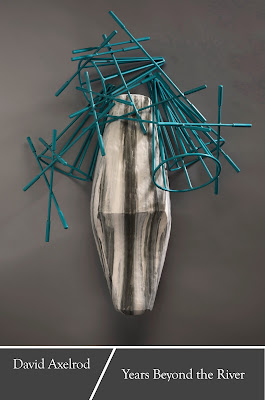
David Axelrod’s ninth collection of poems, Years Beyond the River, appeared in 2021 from Terrapin Books. His second collection of nonfiction, The Eclipse I Call Father: Essays on Absence was published by Oregon State University Press in the spring of 2019. Axelrod directs the low residency MFA and Wilderness, Ecology, and Community programs at Eastern Oregon University. He makes his home in Missoula, Montana.
Heather Swan is the author of the poetry collection A Kinship with Ash (Terrapin Books), the chapbook The Edge of Damage (Parallel Press), which won the Wisconsin Chapbook Award, and the creative nonfiction book Where Honeybees Thrive: Stories from the Field (Penn State Press) which won the Sigurd F. Olson Nature Writing Award. She teaches environmental literature and writing at the University of Wisconsin-Madison.
Please visit the
Terrapin Bookstore for these and other Terrapin Books.